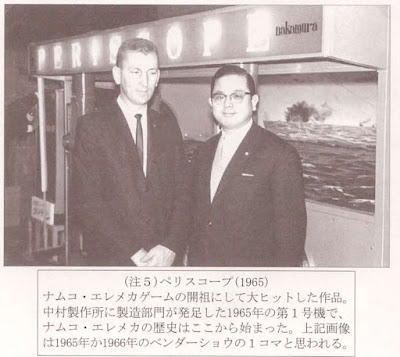
Namco has done a great job advertising their history, but through their publications many errors have cropped up. I do not think this is the 1965 version in this image. For whatever reason, it might have been easier for them to just collapse the more complex history into one single entry.
For example, in Nours 45 it says 1963 and that's most definitely wrong.
Some of the early dates jump around in game timelines in Namco publications, but certainly not by that much.
the caption says "this appears to be from a vendor show" [Sawano, 2017]
This Periscope was called Model NP-3D in the flyers. This designation separates it from the 1965 version, and the NP-3D model is the "new" Periscope version of 1966.
can you understand the blurry text?
When an English flyer exists that tells us they were exporting it.
While the game has PERISCOPE written along the top, it is also referred to as 魚雷発射機 in the 1969 Machine Directory, which translates to Torpedo Launcher.
There is a 1966 version of this machine that seems almost the same, and some people have suggested it is an improved model. In the 1969 Machine Directory we see BOTH versions advertised though. Some times we see games that have an initial version, and are then replaced by an improved version shortly after. If both were being sold in 1969, it implies it was not just a iterative improvement. Both machines are ALSO in the 1972 Machine Directory! But then neither is in the 1973 directory. They both had quite an exceptional run.
1969 directory entry
1969 directory entry [NP-3D model]
Let's compare the specs:
1965: 2500mm height x 3400mm wide x 2600mm deep
1966: 2000mm height x 3600mm wide x 2500mm deep
The 1965 unit is a half-meter taller, so perhaps the 1966 edition was more appropriate for arcades with normal ceilings, and the original 1965 model more appropriate for rooftops and locations with less size constraints. (for Americans: 98.4" vs 78.7", or 8.2 feet vs 6.5 feet)
Note that the export flyer for the NP-3D (1966) version says 350cm (3500 mm) wide. The other dimensions match.
The 1965 picture we have shows a different instrument panel at the front (1965 has a valve wheel, 1966 has 5 switches plus a coin door in the instrument panel,) but I am unsure if the 1965 style of machine kept that same door style.
From NG Magazine we find the article シューティング (history of shooting).
so 1965 Periscope, and then 1966 Periscope (New). I do not think I have seen this distinction elsewhere, but it explains why 2 versions exist in the 1969 machine directory. It is the 1966 version that is widely known.
In the 1972 machine directory this machine is also referred to as 魚雷発射機 (Torpedo launcher) and in the index it says it was made by 中村製作所 (Nakamura Seisakusho).
index from 1972 machine directory
This version of Periscope is much more obscure, with the 1966 model, the NP-3D, the one that seems to be more widely seen.
Name: The World Series - ワールドシリーズ Year: 1972, 1976 Manufacturer: 三共 (Sankyo)
The World Series was released at least twice, with at least 3 backglasses. I do not know if there are any physical differences between versions. If a game is re-released and there are new features, I want to make a separate entry for it. (examples: Mini Drive, Crazy 15) Currently I do not know of any differences between the versions, except for the artwork. If I can find more information that highlights differences, I will create separate entries.
The earliest mention I can find of The World Series is in 1972. I have not seen any earlier mention than 1972. The World Series does not appear in the 1972 machine directory. The World Series appears in the 1973 machine directory.
The playfield is dominated by a baseball diamond which uses balls to simulate players running around the bases. This echoes the very beginning of pinball in Japan! Some of the very first Japanese-made pinball / smartball games had this diamond. These games were all copies of games made by USA companies, but are still very important as they mark the start of pinball in Japan. Compare these with World Series.
It appears the Home Run has two buttons at the front, and on The World Series the buttons are now on the side, like a proper pinball machine. The actual playfield layout appears to be nearly identical.
Back to The World Series...
The 1976 re-release is referred to as ニューワールドシリーズ (New World Series) in Sankyo's advertisements. It did not get a lot of press. During that year, Sankyo were promoting their new games Advantage and American Football. I think they wanted to focus on those games, and The World Series did not get a large promotional push. The 1976 version is ¥30. The earlier versions are probably ¥20 or ¥10, but I am unable to confirm. I have not seen detailed photos of the earlier version.
1972 advertisement for The World Series - ワールドシリーズ by 三共 (Sankyo)
This next version appears to have the same cabinet design as the original, just a different backglass. The colours on the playfield look the same.
1976 advertisement
The 1976 version, referred to as ニューワールドシリーズ (New World Series) in advertisement, believed to be 1976. Though we have an absolute appearance in 1977.
the entry in the 1976 Machine Directory still has the original backglass.
The World Series is listed as being shown by Sankyo in the 14th Amusement Machine Show in 1976:
1976-10-15 Game Machine magazine
This is a small picture of Sankyo's booth at the Amusement Machine Show. On the left is their American Football ( アメリカンフットボール) table, and then two copies of Advantage (アドバンテージ).
1976-11-01 Game Machine magazine
The World Series is not listed as part of the Sankyo booth in the 1977 Amusement Machine Show (15th annual show). There are no advertisements that have pictures of the game in the Game Machine archive.
A few Sankyo advertisements include a mention of The World Series, like this one:
Game Machine 1976-11-15
And here is a photo of an arcade that has The World Series next to Homerun King II
Game Machine 1977-02-15
We are very grateful for OneMoreTimeC (site) posting these videos!
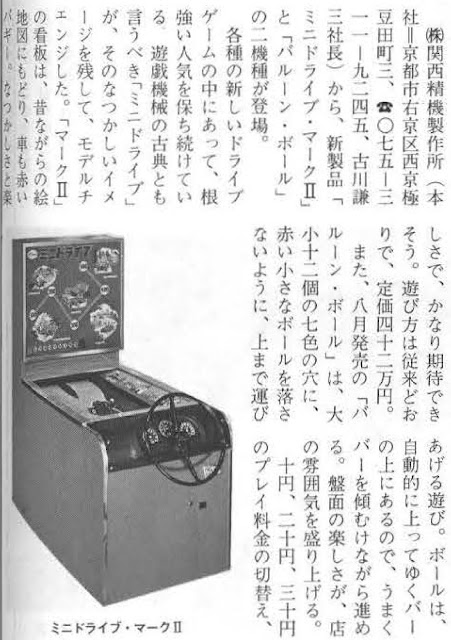
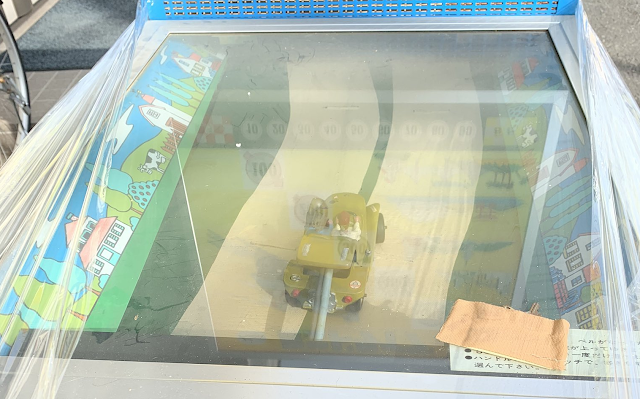
This version of Mini Drive is much more common than then 1958 version. It has a "striped" backglass and a gear shift on the left-hand side to let players go fast or slow. Slow speeds would be better for younger children. The "Kasco" brand logo can be seen. Kasco is a brand of Kansai Seiki.
This model also adds dials by the steering wheel, and now costs 20¥ to play.
The first reference I have to this version is in the 1973 Machine Directory, which was published in late 1972:
This advertisement says the original came out 15 years ago, so 1972 seems like a good guess for the date of this game. I am just going to call it the "[new version]" since I can't find any official title.
The most iconic Japanese arcade machine ever made. 1958 is always listed as the date for Mini Drive, but I am unsure if the original Mini Drive of 1958 is different than what I'm showing here. The M-Type Mini Drive does not have a gas pedal, that would come later in the MA-Type.
This is actually the second version of the backglass:
2nd revision backglass
According to this article, the original backglass showed a journey from Kobe to Tokyo. This was changed, to "Kitakyushu to Sapporo". We do not know when the backglass was changed.
Amusement Journal
First version of the Mini Drive:
original backglass - to identify it quickly, look for the tall building on the left
from the 1969 Machine Directory
This photo shows even another alternate backglass, with what looks like fish along the bottom.
These 2 machines have the original backglass in 2 different colours:
The "MA" type has a pedal on the bottom right of the machine. All of the pictures I have seen show a backglass with two "dials" graphics. The two "MA type" machines in the photo below seem to have different shades of backglass. The front panel of the machine on the right also seems darker.
entry in 1969 Machine Directory
This advertisement is from 中村製作所 (Nakamura Seisakusho) but they also distributed machines for 関西精機 (Kansai Seiki). Note the company name at the bottom of the flyer.