Showing posts with label medal. Show all posts

Monday, 20 July 2026

1979 Super Game - スーパーゲーム [alien] by 三葉 (Mituba)


Name: Super Game - スーパーゲーム [alien]
Year: 1979
Company: 三葉 (Mituba)

Super Game is a smart ball medal game  Think of it like an arrangeball, but in smart ball form. You insert a coin and then get 16 balls to reach a goal of 100+ points.

Similar to arrangeball games that typically have an instant payout cup, the green '5' hole immediately pays out 1 coin. If you reach 100 points you can earn your first medal, and I think it pays out another medal for each 10 points beyond that.  (100, 110, 120, etc)


Game Machine 1979-05-15
note that the model pictured has a different layout

OCR:

メダル式スマート風営機「スーパーゲーム」が三葉産業から

新型の風俗営業機が昨年暮から発売されている。 いわばメダル式のスマートボールで、機種名「スーパーゲーム」。ブレイフィールドの変化があって「ジェット号」、「アタック号」、「フラッシェ号」の三種が、三葉産業㈱(本社=東京都中野区中野五の三十の二、三八五十三一四一)から発売中である。メダル一枚を投入すると玉が十六個出てきて、 打球により、、の入賞穴に入れるとデジタル表示板に点数が加算される。一ゲーム終了時点で得点が百点を越えるとメダルが一枚、さらに十点きざみで一枚ずつ増えるという計算。従って百十五点だと二枚のメダルが払い出される。ボーナス穴で一枚払出。ただし全部で一ゲームあたり最高十枚の払出しである。
アレンジ、雀球などの指定遊技との併設で効果ある。定価本体のみ十三万五千円。セット定価は十四万三千円。

Machine translation:

Coin-operated Smart Amusement Machine "Super Game" from Mitsuba Sangyo

A new type of entertainment machine has been on sale since the end of last year. It's essentially a coin-operated smart ball game, named "Super Game." Three variations of the Brayfield model—"Jet," "Attack," and "Flash"—are available from Mitsuba Sangyo Co., Ltd. (Headquarters: 5-30-2 Nakano, Nakano-ku, Tokyo, 3853141). Inserting one coin dispenses 16 balls. Hitting the balls into the designated winning holes adds points to the digital display. At the end of a game, exceeding 100 points results in a payout of one coin, and then one more coin for every 10 points thereafter. Therefore, 115 points would yield two coins. A bonus hole pays out one coin. However, the maximum payout per game is 10 coins in total.

It is effective when used in conjunction with designated games such as Arrange and Mahjong. The retail price for the machine alone is 135,000 yen. The set retail price is 143,000 yen.

It say there are 3 models:

「ジェット号」 Jet

「アタック号」 Attack

「フラッシ 1号」  Flash No. 1

I do not know which layout is which name.  The machine below is the same layout as seen in the article, as shown by moguragumi. (archive)


There are also other Super Game models with different backglasses. As with their earlier smart balls, I presume this means this was an entirely different named series.  I am referring to this series as 'alien' in reference to the backbox art, but it's not an official name. Another version has a white rocket leaving a moon in the bottom-right.  The more commonly seen model has a rainbow across a blue sky, with a hot-air balloon.


instruction card via moguragumi. (archive)


 OCR: 

=遊戯方法=
メタルを投入すると玉が出てきます。
セーフ穴に入ると、表示された点数がデジタル表示に加算されます。
ボーナス穴に入ると、メタルが1枚出て、点数が加算されます。
ゲーム途中でメタルを投入したり、精算ボタンを押すと無効になります。
ゲーム終了後、得点が100点以上の場合は10点増すごとに、メタルが1枚出てきます。
出てきたメタルで再ゲーム出来ます。
ゲーム終了後、余ったメタルは職員までご返却ください。

Machine translation:

=How to Play=
Insert a metal coin to release a ball.
If the ball lands in the safe hole, the displayed score will be added to the digital display.
If the ball lands in the bonus hole, one metal coin will be released and your score will be added.
Inserting metal coins or pressing the payout button during the game will invalidate the game.
After the game ends, if your score is 100 points or more, one metal coin will be released for every 10 points increase.
You can play the game again with the metal coins you receive.
After the game ends, please return any remaining metal coins to a staff member. 


User satokidisc has fixed one of these units and has let me archive the Super Game photos from their account:


it has a rather short payout tube


you can spot a 7812 manufacture date on the transistor


They also shared 2 videos:


Thursday, 23 October 2025

1977 Jupiter-30 - ジュピター30 by ベンドジャパン (Vend Japan) & 大平技研 (Ohira Giken — Yuvo)

Name: Jupiter-30 - ジュピター30
Year: 1977
Company:  ベンドジャパン (Vend Japan) & 大平技研 (Ohira Giken — Yuvo)


Jupiter-30 is the very first game from YUVO that I have recorded.  It was sold/distributed by Vend Japan.  Jupiter-50 and Jupiter-300 will also be discussed in this article.

Here is a flyer I purchased, front and back:

Jupiter-30 - ジュピター30 by ベンドジャパン (Vend Japan) & 大平技研 (Ohira Giken — Yuvo)

Jupiter-30 - ジュピター30 by ベンドジャパン (Vend Japan) & 大平技研 (Ohira Giken — Yuvo)


from the front:


 Transcription:

JUPITER-30
10円又は100円→3段階チャレンジが選択できるプライズマシン。
景品展示窓付。景品(たばこ大) 約80個収納可。金庫10円玉6,000枚収納可。
JUPITER-50
10円、20円→メタル販売機付。メタル配当5枚、10枚、50枚の3段階ステップ・チャレンジ方式。ホッパー採用。
JUPITER-300
本格的メタルGマシン。当り倍率2、5、30の3段階。チャレンジ倍率は追加メタル投入により1~10倍。
配当はチャレンジ倍率×当り倍率の枚数。チャレンジ倍率表示ランプ付。ホッパー採用。

Machine translation:

JUPITER-30
A prize machine with three-stage challenge options for 10 yen or 100 yen coins.
Includes a prize display window. Holds approximately 80 prizes (large cigarettes). Safe holds 6,000 10-yen coins.
JUPITER-50
Includes a medal vending machine for 10 yen and 20 yen coins. Three-stage challenge system with metal payouts of 5, 10, or 50 coins. Features a hopper.
JUPITER-300
A full-fledged Metal G machine. Three win multipliers: 2, 5, or 30. Challenge multipliers range from 1x to 10x by adding additional medal.
Payouts are calculated as the challenge multiplier multiplied by the number of coins with the win multiplier. Features a challenge multiplier indicator lamp. Features a hopper. 

30 is for winning cigarettes. 50 looks the same but uses a coin hopper to payout medals.  I have never seen a picture of Jupiter-300 so I do not know if it uses the same case, but it ups the medal gambling aspects and offers a chance for larger payouts.

Jupiter-30 is one of 3 machines in the series. 30 and 50 use the same cabinet except with the 30 altered to 50.  30 is a prize machine, where rolls of cigarettes can be won!  


Let's take a look at how the gameplay works on Jupiter-30:


According to the back of the flyer, you insert a 10 yen coin and flick it up at the sun.  The sun is attached to a motor and rotates.  You can see a translucent plastic column around the rocket in the center.  If the coin goes down that chute you get to shoot it again.

There are six planets and hitting any of them will cause the reels at the bottom to spin. If you stop each drum at the right position I think it awards you that prize.  I am actually kind of unsure about the specifics of the gameplay of this portion, given how the flyer is written (and my lack of understanding the Japanese language).

Besides the Sun I can make out Mercury, Venus, Earth, Mars, what I presume is Saturn, and then I can't see the writing on the lower-right one. 


Game Machine 1977-08-15

In this advertisement we can see how Jupiter-50 appears to have an identical cabinet:

Coin Journal 1977-11

Jupiter-50 - ジュピター50 by ベンドジャパン (Vend Japan) & 大平技研 (Ohira Giken — Yuvo)

Only difference here is that there is no prize display in the main window.


I hope we one day find evidence of a Jupiter-300 cabinet.

1977 Jet Coaster [Jet Roller Coaster] - ジェット コースター [ジェットローラーコースター] by 日本物産 (Nihon Bussan — Nichibutsu) & 日本ベンディング (Japan Vending) & 東亜セイコー (Toa Seiko)

Name: Jet Coaster [Jet Roller Coaster] - ジェット コースター [ジェットローラーコースター]
Year: 1977
Company: 日本物産 (Nihon Bussan — Nichibutsu) & 日本ベンディング (Japan Vending) & 東亜セイコー (Toa Seiko)

I purchased the Jet Coaster flyer so here is a high resolution copy of it:

download at Archive.org

This is a horror-themed game that asks the player "let's imagine you're on a roller coaster that explodes". 

    THE HORRORS DEPICTED

A note on the title: "Roller" is rolled up in the corner, and the game is often referred to as Jet Coaster, though the full name is Jet Roller Coaster.

a peak inside


But the gameplay is merely another upright roulette game in the vein of Piccadilly Circus.

Amusement 1977-11
At the bottom 日本物産 (Nihon Bussan — Nichibutsu) is listed as "Manufacturer and distributor in Eastern Japan" and for 日本ベンディング (Japan Vending) it says "Western Japan sole distributor".

From an auction listing, we see the Type Approval Number 91-13527 which was registered by the company on the plate 東亜セイコー (Toa Seiko) in 1976.

Type Approval Number 91-13527
 

Jet Coaster appears in both Amusement and Coin Journal November 1977, so if it came out in 1976 we will have to find evidence.

I assume that Nichibutsu contracted the manufacturing to Toa Seiko.


Thursday, 6 March 2025

1978 Grand Prix Four - グランプリフォー by セガ (Sega)

 
Name: Grand Prix Four - グランプリフォー
Year: 1978
Company: セガ (Sega)


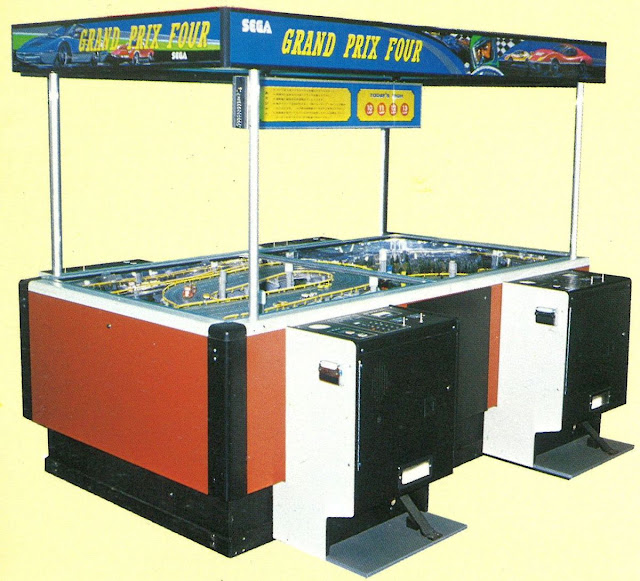
Grand Prix Four is a large medal game that was developed and built by Sega but never made it to full production, despite being exhibited widely in 1978.  It could apparently be played as a medal game or as a regular amusement machine.

Four players controlled slot cars racing around the track.  There are five lanes, with the 5th being for a rescue vehicle.


Game Machine 1978-07-15

English translation: (edited by tweakbod)

Game Machine No. 100 -  Jul.15, 1978 (page 7)
Newly Produced Grand Prix Four
This Year's Sega New Product Exhibition

 Sega Enterprises Co., Ltd.’s (Headquarters: 1-2-12 Haneda, Ota-ku, Tokyo, ☎ 742-3171, President Rosen) annual new product exhibition event was an enthusiastic affair with many invited guests at both the Tokyo and Osaka venues.

Movie Tie-in with Star Ship

 Although a little later than usual, this year's event was held at the Hotel Pacific in Tokyo on June 27th and at the Royal Hotel in Osaka on June 30th, with President Rosen in attendance. Leading companies from all over Japan attended each of these events, and the new product presentations were lively.

 The four-player medal game machine Grand Prix Four, the main game to be announced this time, was placed in the center of the exhibition hall, along with new TV game machines, flippers, Rock-Ola's latest juke 474, and the large screen TV project Sega Vision.

 Grand Prix Four is a miniature car racer that pays out medals when it completes a specified number of laps on the course in a specified time. It is about the same size as a Harness Race, and the action of the rescue vehicle to save a car from an off-course accident is a masterpiece. The course is generally elaborate, with a railroad crossing and other features, but it is all done by electromechanical devices.

 As for TV game machines, the company has high expectations for the space game Space Ship, the company's newly developed base attack game Secret Base, and the driving games Top Runner and Pro Racer. Among the flippers, the latest in the company's CPU series, Knockout Blow, the new Williams Lucky Seven, Hot Tip, and Stern's Stingray are attracting attention.
.
 The only table type exhibited was the company's SuperBowl T II TV game machine. It was also emphasized that the company's four-player gun game machine, Amazonian, had been thoroughly improved.

 At the reception that started at 6:00 pm, Vice President Duane Blough gave a speech (translated into Japanese by Mr. Shinohara), expressing his expectations for the company's Space Ship, which will be released simultaneously with the Star Wars movie, and made a presentation to introduce the products on display. Of these, the most noteworthy was the import trend of European and American flippers, and the company announced that it would be supplying the product as an agent of not only Williams, but also Stern of the U.S. and Interflip of Spain.

 At the reception, there was a lottery with a special prize of one Sega Vision and ten sets of prize-winning Star Wars admission tickets. The venue was filled with excitement when a Sega Vision was presented to Mr. Sato of Tokai Amusement Co., Ltd. at the Tokyo venue and to Mr. Nakui of Taiko Bussan Co., Ltd.

[photo captions]
President Rosen
Vice President Blough

Top left: The upper and middle photos are at the Tokyo venue
Bottom left: The photo below is from the Osaka venue

The "Star Ship" in the title appears to be a typo, where they crossed Space Ship with Star Wars by accident.


Game Machine 1978-10-01

 OCR transcription:

グランプリフォー
セガ社からいよいよ発売に
ミニカーレースをメダルゲーム機化

㈱セガ・エンタープライゼス(本社=東京都大田区羽田一の二の十二、七四二一三二七一、ローゼン社長)から、四人用メダルゲーム機「グランプリフォー」がいよいよ発売される。
これは設定されたサーキットコースをプレイヤーが、アクセル操作して、ミニカーを走らせるというもので、時間内にミニカーをできるだけ多く走らせ、その周数が一定数以上だとメダルが払い出されるもの。
コーナーなどでスピンをして走行不能となったときは救援車を呼ぶことになる。また、コースの途中に踏切があり、汽車が通過するたびに遮断機が降りるが、遮断機に車が衝突すると、それまで走った周数がゼロになってしまう。
標準型ではメダル投入口と百円硬貨投入口の2ウェイになっており、いずれも周数によりメダル(リプレイ用)が払い出される(百円→メダル六枚に換算)。別途コンパ 

Machine translation:

Grand Prix Four
Finally on sale from Sega
Minicar race turned into a medal game machine

Sega Enterprises Co., Ltd. (Head office: 1-2-12, 74213271 Haneda, Ota-ku, Tokyo, President: Rosen) is finally releasing the four-player medal game machine "Grand Prix Four".
The player operates the accelerator to drive a minicar around a set circuit course, and if the minicar runs as many laps as possible within the time limit, medals are paid out if the number of laps is more than a certain number.
If the car spins out at a corner and becomes unable to run, a rescue vehicle must be called. There is also a railroad crossing in the middle of the course, and a barrier is lowered every time a train passes, but if the car hits the barrier, the number of laps it has run up to that point becomes zero.
The standard model has two ways, a medal slot and a 100-yen coin slot, and either one pays out medals (for replays) depending on the number of laps (100 yen is converted to six medals). A separate compact is available.


1978 AMOA - I think this image is from Replay magazine

Amusement Industry 1978--07


Via web Tampa '80年代ゲーム同人を自ら振り返る (archive) here are watermarked images of the flyer:


From the article, they identify the cars used in Grand Prix Four.  I will excerpt, but include machine translation as well.

寛斎:グランプリ・フォーについては、AFXにハマってた私が少し補足します。アメリカのオーロラという会社のスロットレーシングを1980~82年頃、
トミーが日本での販売権を得たのか、トミー/オーロラAFXとして発売しました。オーロラでは、車の仕様を改良したものを追加発売していきましたが、
日本ではベーシックなものを「マグナカー」オーロラで「G-PLUS」と言っていたものを「スーパーマグナカー」として発売。
その他「スペシャル・マグナカー」という第3のシャーシ、さらに当時の「チューニングマニュアル」1ページ目のカタログに、
「ハイスーパーマグナカー」という第4のシャーシも載ってますが、それはおそらく、F1ブームのときに日本でも発売された、マグネットが追加された新シャーシだろうと推測してます。

Kansai: I'll add a little about the Grand Prix Four, as I was obsessed with AFX. Around 1980-82, Tommy acquired the sales rights in Japan for slot racing from an American company called Aurora, and released it as Tommy/Aurora AFX. Aurora released additional models with improved specifications, but in Japan, the basic one was called the "Magna Car," and what Aurora called the "G-PLUS" was sold as the "Super Magna Car." There was also a third chassis called the "Special Magna Car," and in the catalog on the first page of the "Tuning Manual" at the time, there was also a fourth chassis called the "High Super Magna Car," which I believe was probably a new chassis with magnets added that was released in Japan during the F1 boom.

画像 AFX「チューニングマニュアル」1ページ目
AFX "Tuning Manual" page 1

ゴンス:当時あーたとAFXの話なんかしなかったから、今聞いても全然ピンとこない(爆)

寛斎:マグナカーの一覧が出てきたので、グランプリ・フォーに使われてた車種をAFXのカタログから紹介します。

Gons: I didn't talk about AFX with you back then, so even if I hear about it now, it doesn't make any sense (lol) 

Kansai: Now that I have a list of Magna cars, I'll introduce the models used in the Grand Prix Four from the AFX catalog. 


寛斎:左から、「ダッヂチャージャーストッカー」「コルベット」「マーキュリーストッカー」で、これだけは買ったマグナカー封入のカタログから、
「シボレーストッカー」。真ん中の赤い「救援車」は私の知る限りAFXのカタログからは見つけられませんでした。
当時操作したような気もするのですが、車体後方に付け根がある黄色いバーが、ボタンを押すと救援車前方から扇状に後方に向けて開いてたはずです。
ただ、走行不能になった車を、救援車でどうやって救ってたのか、記憶にないんですよね。

Kansai: From the left, "Dodge Charger Stocker", "Corvette", "Mercury Stocker", and from the catalog that came with the Magna Car I bought,
"Chevrolet Stocker". As far as I know, I couldn't find the red "rescue car" in the middle in the AFX catalog.

I think I operated it back then, but when I pressed the button, the yellow bar at the base of the rear of the car would open up in a fan shape from the front of the rescue car to the rear.

However, I don't remember how the rescue car saved cars that couldn't run.


Nazox2016 has a great writeup about Grand Prix Four (archive) - read through Translate.

His article also includes a cleaner shot of the train that can block your progress.


Amusement 1978-09


Wednesday, 10 January 2024

1966 Ascot - アスコット by セガ (Sega)


Name: Ascot - アスコット
Year: 1966, 1973
Company: セガ (Sega)

This is not an easy machine for me to catalogue since it was initially an export machine, and then was a domestic machine 8 years later.  For the time being, this article will discuss both iterations.

The earliest record I've found of Ascot is the debut at the A.T.E. show in London, 1966:

Cash Box 1966-12-17 page 67


Excerpt from Cash Box 1966-12-17
"R & W (as they are known throughout the British industry) are also main distributors for Sega fruit machines and they showed two versions of the new Ascot - one is on penny play and the other takes a threepenny coin or a special size check."

A 'check' is a non-money coin token.  These were created to get around gambling legislation that made paying out monetary coins illegal, and would also serve the function limiting winnings to the location. In Japan, the equivalent term 'medal' was used when sen payout on machines was made illegal.

I am unsure if the token shown below is the special Sega check that Ascot used at the 1996 A.T.E. Show, but I think that is a safe assumption. 

Via Sega Retro, here is a photo of the Ascot token:


1966-12-17 Billboard


During the medal boom of the 1970s, Sega sold the machine domestically in Japan.  The UK machine would be 240V, and the Japanese one 100V, probably with a step-up transformer inside.  They used Type Approval Number 91-9425 which was registered in 1973. This means that despite making it in 1966, they did not bother to register it with the electrical authority until they sold it domestically in the 1970s.

Sega 1974 catalogue


1974/1975 machine directory entry

I was told that work on the domestic Ascot was done in 1973.  I have yet to find any reference of Ascot being sold in Japan in 1973, but I will use 1973 due to the Type Approval registry date. 

Sometimes slot machines were used for underground gambling, but I have not found any reference of Ascot specifically being used within Japan before 1974.

There appear to only be a few aesthetic differences between the machines: The English signage with instructions has been replaced with more horse art, and the roulette glass has been altered.  The 5 positions with blue+white hatching have been replaced with more numbers.

7-coin horse race gambling devices go back decades, but post-ww2 console slots were quite popular in the USA, with "flashers" coming into prominence as a way of avoiding legislation around spinning reels.  One of the most iconic of these are the "Winter Book" games.

1946 Winter Book by H.C. Evans

1946 Winter Book by H.C. Evans

As of writing this, I have evidence of 4 different Japanese machines that used the Winter Book name, though there many other machines that followed the same basic principle, Ascot one of them.

a foreigners' guide to eremeka arcades - 外国人のためのエレメカアーケードゲームガイド: introduction & main page - 紹介&メインページ

eremeka search tool  // エレメカ検索ツール begin browsing at the beginning / 最初から閲覧を開始する begin browsing at 1960 / 1960年代から閲覧する begin browsing at 1970...