Showing posts with label company-satomi. Show all posts

Friday, 20 September 2024

1970 Daishogai - 大障害 by さとみ (Satomi — Sammy)


Name: Daishogai - 大障害
Year: 1970
Company: さとみ (Satomi — Sammy)

Daishogai was released in 1970, and was amongst the games listed at Expo '70.
All Japan Amusement Park 1970-11

This is a skill-based game where you rotate the knob to guide a ball down the tracks and into a winning hole on the bottom.  You can learn more about this style of game in the Niche Mechanisms 004: Rotation article, section 2-2: Rotation - Fire Escape style.  This style of game has been around since at least 1936.

なんたって18歳! 第36話「ピリカメノコは恋の花」(1972年6月6日放送)
(via @TOO_yoshikawa)

Amusement 1973-02


flyer


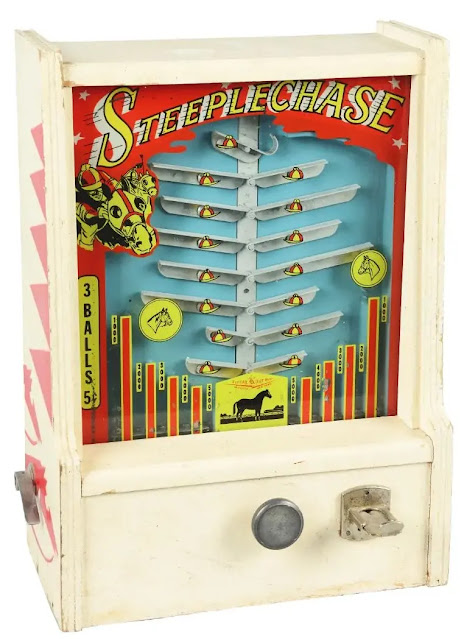
In 1968, the USA company Irving Kaye released the game Steeplechase.
1968 Steeplechase by Irving Kaye


Coin Box 1968-05-18


Daishogai seemingly utilizes some of the same hardware as Steeplecase, or is at least probably copied from it.
Steeplechase has a handle to shoot the ball up on the left side, Daishogai on the front.  Daishogai has a singular goal to enter to win a prize, while Steeplechase gives you multiple balls to build a higher score for amusement's sake.

On Steeplechase, and on every other version of this style of game, the ball alternates direction on each platform.


Daishogai has two places where the ball travels down the same side, 2 levels in a row!  This seems like a mistake in the design, but I also wonder if they had a shortage of some of the parts?

I do not think Steeplechase was a big seller.  It would certainly be possible that some of their parts were purchased by Satomi, especially when we consider that Satomi seemingly has a history of purchasing parts of foreign games to build new games.

This ball path does not seem to be an error made for the flyer.  In the 1973 photo above, we can see this odd ball path:  Left, left, right, left, left, right, left, right.


A photo of the machine was taken from an auction in 2026:


Thursday, 18 April 2024

~1969 Pony Derby - ニューポニーダービー (New Pony Derby) by さとみ (Satomi — Sammy)


Name: Pony Derby - ニューポニーダービー (New Pony Derby)
Year: ~1969
Company: さとみ (Satomi — Sammy)


flyer

The backglass says Pony Derby, but most written references call this New Pony Derby, presumably to differentiate it from the first version in 1965.  The text below says there are five coin holes, though I can't see them very well.  Player(s) bet with 1-5 coins, and winning dispenses one of the 5 prizes, which I assume were always cigarettes.

1969 machine directory entry

There is another version of this same model: Pony Derby - ニューポニーダービー (New Pony Derby) by 昭和娯楽物産 (Showa entertainment products) & 日本遊園設備 (Japanese amusement park equipment).  Please reference that article for a look at the cigarette prizes.

That version existed at the same time, and I am unsure if there are significant differences.

from an article on Satomi history

At a Satomi display from 1976 we can see the upper wall is decorated with images of past machines, and we can clearly see New Pony Derby, with a line running down the center of the cabinet:
Game Machine 1976-11-10

The version by Showa Entertainment Products does NOT have the line in the cabinet, and has a slightly different backglass.  For reference:

Pony Derby - ニューポニーダービー (New Pony Derby) by 昭和娯楽物産 (Showa entertainment products) & 日本遊園設備 (Japan amusement park equipment)
slightly different backglass, cabinet, payout cup, and front panel....


By 1966 Keeney began using wider payout slots that are quite similar to the payout slot we see on New Pony Derby.  That is to say, I can't disqualify a connection to Keeney for this machine.  The continued influence would be understandable, as Satomi was yet making machines from scratch, but repurposing imported parts.

1966? Super Blue Spot by Keeney

Keeney also made a wide slot that took their prior payout cup and made it wider:

Tuesday, 16 April 2024

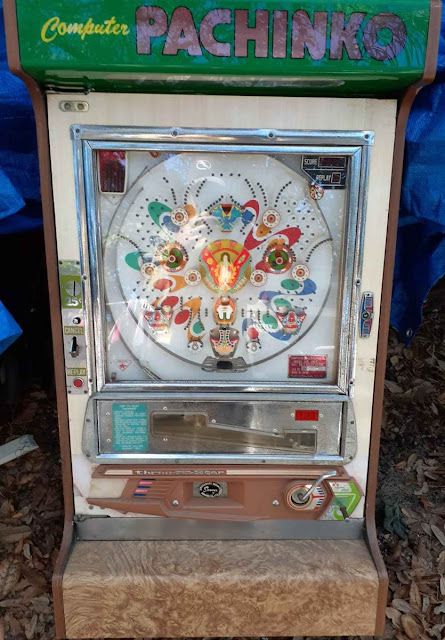
1976 Computer Pachinko - コンピュータパチンコ by さとみ (Satomi — Sammy)

Name: Computer Pachinko - コンピュータパチンコ
Year: 1976
Company: さとみ (Satomi — Sammy)

Pachinko machines are only allowed a year of service after their inspection approval.  Most pachinko machines will have tags that show the approval expiry date.  I believe Computer Pachinko was a novel way to recycle the older pachinko machines.  A coin mech and button gets added on the left, and the display counters get added to then upper-right, and the pachinko machine is built into a custom cabinet.

It makes me wonder how many of the prior pachinko-style arcade games might have involved recycling old pachinko parts.

Game Machine 1976-11-01

This mentions that Computer Pachinko was made for overseas, but we also do see it sparingly in Japan.

Coin Journal 1977-02
being sold by UPL (Universal Play Land)


The schematics for Computer Pachinko were scanned by Pachitalk user Jaelus.

They are now available on the Internet Archive as PDF, and below as images.

Computer Pachinko schematics page 1

Computer Pachinko schematics page 2

Computer Pachinko schematics page 3

Computer Pachinko schematics page 4


Computer Pachinko in the USA:
1976-06 Replay magazine

USA flyers of Computer Pachinko being sold by Amutech Ltd. from California, USA.


The schematics above were found with a different machine... Computerized Pachinko.  Some companies in the USA took Satomi's lead (and apparently their schematics?) and started selling their own models of coin-op pachinko machines, and used a similar name, Computerized Pachinko.
Container shipping had been increasing in usage, with the price of shipping containers falling, and the 1970s were when machines that had expired past their 1 year parlor license were sold en masse to companies in the USA.  (Prior to the containers of machines in the 1970s, most pachinko in the USA was, seemingly, from soldiers bringing them home from bases around Japan.  They certainly made a novel souvenir, and were probably quite cheap since they couldn't be used any more.)


Here is one Computerized Pachinko:
Computerized Pachinko by Marvena International, California

Computerized Pachinko by Marvena International, California

This next one looks similar to the one above, but has a dummy "0" in the score to avoid paying for an extra display.  The one in the pachitalk thread seems to be the same model.
Computerized Pachinko by Marvena International, California

Computerized Pachinko by Marvena International, California - inside

considering this expires July 31, 1976 it is probably first generation of Computerized Pachinko.


Pics of the one from the pachitalk thread:
Computerized Pachinko by Marvena International, California

Computerized Pachinko by Marvena International, California

Computerized Pachinko by Marvena International, California

The above machines have boards with the "Sammy" brand visible on them, so either the parts came from a Computerized Pachinko, or Satomi sold the parts as a kit.  The Satomi boards are notable for the sub-board that lets you select the replay value between 80-120.

Another model variant, Coin Operated Pachinko, by a company out of Florida.  This does not use the Satomi boards, but it keeps the coin mech style of the Computerized Pachinko.
Coin Operated Pachinko by Performance Enterprises, Florida

Coin Operated Pachinko by Performance Enterprises, Florida - back


Another one, this one has the coin slot built into the machine on the bottom left.  The circuit board is similar to the one above, and not from Satomi.  These are  probably later models, as they've seemingly developed their own board.
The title is slightly different, Electric Computerized Pachinko.
Electric Computerized Pachinko front

Electric Computerized Pachinko inside

Sunday, 24 December 2023

~1969 Skee Ball - スキーボール by さとみ (Satomi)

Name: Skee Ball - スキーボール
Year: ~1969
Company: さとみ (Satomi)

Skee Ball appears in the 1969 machine directory.  We know Satomi began in 1965, and their first original game was Sonar Attack in 1968.  Skee Ball appears to be a copy of a Chicago Coin game, so this could have been released any year between 1965 and 1969.

1969 machine directory


flyer


While I do believe this game is built nearly entirely of imported parts, I am not marking this as an import. The stand and artwork are new.  The marquee follows the design of the original, but was entirely new.

Chicago Coin Midget Skee Ball was released in 1949.


This video shows off the 1949 Chicago Coin Midget Skee Ball, and shows some gameplay.  The Satomi machine would have the same gameplay, as it appears to be all of the same parts. 

The game Pitch Ball is the exact same as Skee Ball, but with a different backglass.  According to the Morphy's Auction Listing (archive,) this is from 1972.  I do not know where they got that date from, but it is the only date I have found so far.

I believe this machine was made for export, due to the 10 cent coin slot.  I guess that after Satomi began exporting their first machine, Sonar Attack, they revisited this machine to expand exports. Skee Ball would be a trademark in the USA, so the new name, Pitch Ball was used.

1972 Pitch Ball by さとみ (Satomi)

1972 Pitch Ball by さとみ (Satomi)

Note the Canada/USA style coinslot.  The wood playfield seems to be exact to Midget Skee Ball, reinforcing the idea that these are old stock parts.  The green backflash looks different in this version, but those would also be the parts most potentially vulnerable to weather and atmospheric conditions.

a foreigners' guide to eremeka arcades - 外国人のためのエレメカアーケードゲームガイド: introduction & main page - 紹介&メインページ

eremeka search tool  // エレメカ検索ツール begin browsing at the beginning / 最初から閲覧を開始する begin browsing at 1960 / 1960年代から閲覧する begin browsing at 1970...