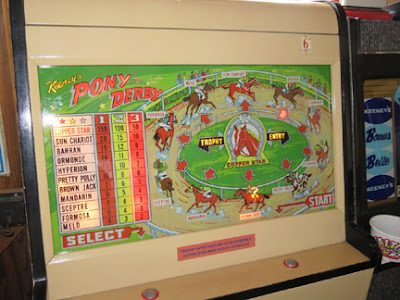
The backglass says Pony Derby, but most written references call this New Pony Derby, presumably to differentiate it from the first version in 1965. The text below says there are five coin holes, though I can't see them very well. Player(s) bet with 1-5 coins, and winning dispenses one of the 5 prizes, which I assume were always cigarettes.
That version existed at the same time, and I am unsure if there are significant differences.
from an article on Satomi history
At a Satomi display from 1976 we can see the upper wall is decorated with images of past machines, and we can clearly see New Pony Derby, with a line running down the center of the cabinet:
Game Machine 1976-11-10
The version by Showa Entertainment Products does NOT have the line in the cabinet, and has a slightly different backglass. For reference:
Pony Derby - ニューポニーダービー (New Pony Derby) by 昭和娯楽物産 (Showa entertainment products) & 日本遊園設備 (Japan amusement park equipment) slightly different backglass, cabinet, payout cup, and front panel....
By 1966 Keeney began using wider payout slots that are quite similar to the payout slot we see on New Pony Derby. That is to say, I can't disqualify a connection to Keeney for this machine. The continued influence would be understandable, as Satomi was yet making machines from scratch, but repurposing imported parts.
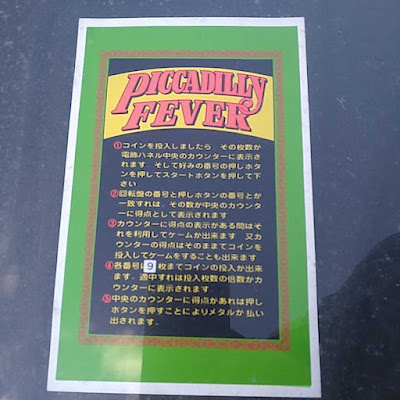
Starting at 3:12 in this video, you can see Piccadilly Fever in action:
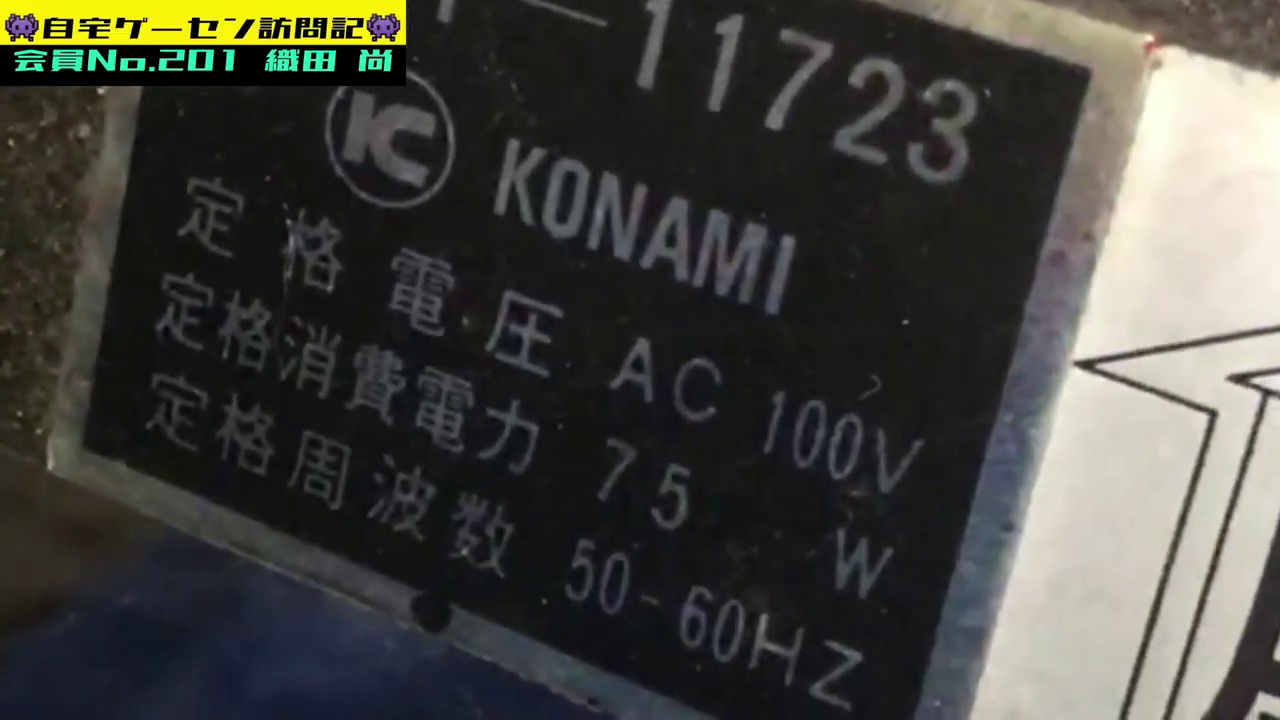
In the video they show us the maker's plaque:
TAN # 91-11-11723
I find it interesting that the game is labelled as both by レジャック (Leijac) & コナミ工 (Konami) here, so I have included both companies in this entry. I am unsure if Leijac is a brand for Konami, or still a separate legal entity.
Company: 昭和娯楽物産 (Showa entertainment products) & 日本遊園設備 (Japanese amusement park equipment)
This machine only appears in the 1969 machine directory, and so we can only say that the year of release was ~1969, but it could have been earlier.
While the backglass says "Pony Derby", the advertisement and all of the catalogue entries refer to it as New Pony Derby. We do not know if or how Keeney and/or Satomi are involved with this machine, if at all. This machine is a nearly exact copy of Satomi's New Pony Derby, with only minor differences.
At the bottom of the advertisement, 日本遊園設備 (Japanese amusement park equipment) is mentioned.
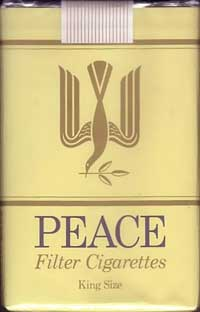
Looking at the right-side of the machine we see 5 prize slots and we were able to match up the 3 colour blobs to vintage Japanese cigarette logos. (Thank you to EM好きおじさん for the extra cigarette information)
Pony Derby is a medal game seemingly built from parts of Keeney's machine. (I had originally spoken about this machine being an "import", but I have reconsidered. The source of the parts is irrelevant for designating the company.)
This tells us 里見治 (Satomi Hajime) was born in 1942. He entered university in 1960, and while in university he began selling game amusement machines. サミー工 業 (Sammy Industries) was founded in 1975. They became サミー (Sammy Corporation) in 1997.
23歳で独立してアミューズメント機の販売を始めた里見だったが、アミューズメント機の需要が多くなってくると、㈱セガや㈱タイトーなど大きなメーカーが製造だけでなく直接販売もするようになった。こうなると、メーカーからゲーム機を買って販売していた里見は価格面で太刀打ちできなくなった。 "Satomi started selling amusement machines independently at the age of 23, but as the demand for amusement machines increased, large manufacturers such as Sega Corporation and Taito Corporation began not only manufacturing them but also selling them directly. When this happened, Satomi, which had been buying game consoles from manufacturers and selling them, was unable to compete on price."
That would mean that Satomi began selling amusement machines around 1965. The final sentence helps reinforce that these would be refashioned Keeney parts.
caption at the bottom: (株)さとみが最初に市場へ投入したアミューズメント機 「ポニーダービー」 "Pony Derby, the first amusement machine introduced to the market by Satomi Co., Ltd."
If that text is accurate, it means the year for Pony Derby is probably close to 1965, but I will hedge on ~1966.
If you look closely, you'll see that it uses the "Samy" brand:
They dropped the "To" from Sa-to-mi to make "Samy". By 1970 this would be spelled as "Sammy".
Pony Derby is a bit of a mystery to me. It was a machine first made by Keeney in the USA in 1964. There were many new laws against gambling machines in the USA (the latest wave began in the mid 1950s) and in the 1960s the legislation was altered to allow for transport of gambling machines. Keeney was selling console slot machines to the UK market via Mar-Matic.
Cash Box 1964-02-01
Cash Box 1964-02-01
In that same issue we get a glimpse of the Mar-Matics booth at ATE.
it is nigh impossible to see, but beneath the "L" in Limited is a machine I believe to be a Keeney Pony Derby based on the rough cabinet shape, legs, and payout slot. Cash Box 1964-02-01
Pony Derby was also scheduled to make an appearance at the 1965 ATE Cash box 1965-01-23
The machines being brought into Japan are very different in appearance than the ones for the UK and USA. (With that statement I am assuming there were still some select markets in the USA that they were sold to.)
I have not heard of anyone else owning or discussing one of these, so I am unsure if they were successful. Given the lack of mentions in magazines and by collectors, I assume it was not a success compared to their other slot machines.
The Japanese Pony Derby also has an entirely different backglass than the regular Keeney Pony Derby.
1964 Penny Derby (1D Derby) by Keeney (note: this image has been stretched from its original form into the current perspective)
Thank you to Chris Dade for the revelation that what we see in Japan is actually a reworking of "Penny Derby", which was released at the same time as Pony Derby. If you look at the Cash Box articles above, it is referred to as "1D Derby", 1D being how British currency referred to a penny then.
1964 Penny Derby (1D Derby) by Keeney
1964 Penny Derby (1D Derby) by Keeney
Satomi's Pony Derby uses the iconic metal castings that we see on both Keeney machines, Pony Derby and Penny Derby.
Note: These castings are not found on the machine "New Pony Derby".
The small metal payout cup is typical of Keeney slot machines of that era.
The game play of Keeney's Pony Derby is very basic. One button to select your horse, and one button to start. The Satomi Pony Derby also has just these two buttons. Earlier Keeney slot machines had an iconic metal handle that would rotate to start (see the Blue Spot photo above) but that was not used on Pony Derby, just the Select and Start buttons.
It seems that Keeney created a special version of this machine for export to Japan. The differences:
Different cabinet dimensions
Different buttons locations
the backglass has many differences:
The odds are not on the glass
the name was changed from Penny Derby to Pony Derby
The Trophy Entry and Copper Star areas in the upper-right were moved further to the right.
1964 Penny Derby (1D Derby) by Keeney flyer via Chris Dade
This is one of the last machines made by H.C. Evans, or perhaps the last, as the company folded in 1954 under the weight of the numerous anti-gambling laws,
This is a "flasher" machine, a style of machine made to circumvent laws that described slot machines as having spinning reels. Instead of spinning reels, lights would flash on and off in succession to simulate the rotation. (Mind you, the 'flashing' in this game is simulated thanks to a spinning lamp.) This machine also did not payout, it kept credits won on displayed on the backglass and a proprietor would have to pay out the player(s) manually.
I mention this machine because of the distinctive artwork on the playfield glass:
Press the buttons to select one or more horses, press start and it appears there is a 1 in 21 chance the number you chose will come up.
There is even an old youtube video that shows some of the internals.
I do not know for sure, but in this video the spinner wheel appears to have around 21 stop positions, so perhaps that means the game can stop on the green spaces between the numbers? The contact disk definitely has 21 positions, but that is so all of the lights can flash during rotation. If you were going to only have 7 win positions, you wouldn't need that many teeth for the wheel to stop on. There is a chance it was required for the design though, and that multiple stop points map to one specific number. I hope to get in touch with someone who owns this to confirm.
This gameplay, the rows of 7 buttons, and some of the artwork show up in these Japanese machines.
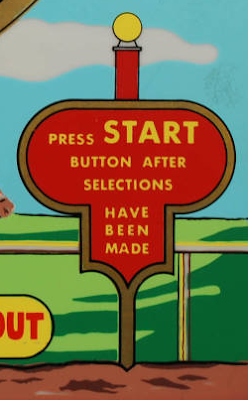
What caught my eye was the sign with instructions on it. Unmissable, and the text on the Japanese machines is exactly the same.
The lower horses are not copied on the Japanese games, but the general composition is copied. The wheel is mostly the same, but similar flasher wheels were used on a few other USA machines as well. It is really the direct copying of the sign that intrigued me the most.
All of the Japanese machines have similar gameplay: bet on a horse by pressing a button, press start, and win if the flasher lands on your number. Even the buttons on the Japanese machines mostly look similar to the Saddle & Turf ones.
Here is what I see as the first iterations of this machine:
Mini Derby - ミニダービー by 大森 (Omori) & 三協商事 (Sankyo Shoji)
New Mini Derby - ミニダービー by フジ (Fuji)
Derby 200 this might just be a new graphic for the Mini Derby machine
フジ・エンタープライズ (Fuji Enterprises) is given as the maker of Mini Derby the 1976 machine directory. But in a book by Onitama-san, 三協商事 (Sankyo Shoji) is given along the date of 1974.
1976 machine directory
And if we look at the manufacturer plate, it was built by Omori.
大森 (Omori) TAN 91-9368 this is the same Type Approval Number that Stage Girl has
TAN 91-9368 was registered in 1973, but that does not mean this machine came out that year. 1974 is the year as given by Onitama-san's book.
On the New Mini Derby above, take note that it looks like the "New" is a translucent sticker:
But they also did print it properly on the backglass at some point:
It is not rare to hear about iterations in development, and "New Mini Derby" probably represents some engineering improvements. Looking at their internals, it's mostly identical except Mini Derby has a sub-board and extra visible capacitors, so New Mini Derby probably represents a more streamlined design with a slightly reduced bill of materials.
Derby 200 does not have a front-facing payout cup. It probably ejects coins out the bottom, and so would have to be placed over a tray. The images I have show an on/off switch at the bottom at the back, reinforcing the idea that it wasn't meant to stand flat on a countertop.
rear, bottom of Derby 200 show the on/off switch
These machines are more advanced that Saddle & Turf. First off, they have a payout mechanism. Gameplay wise, the center of the circle (I assume) randomly chooses the potential award each race.
The above games are already feel old compared to 1974 standards, I am assuming New Mini Derby is from 1974 or 1975 at the latest.
We know this style of machine was around in 1972, as there is another variant visible in a 1972 TV show:
Winter Book アイちゃんが行く! 第12話「ここは仙台青葉城」(1972年11月17日放送) Ai-chan is going! Episode 12 "This is Sendai Aoba Castle" (broadcast on November 17, 1972)
full screen shot, I don't remember the source:
Winter Book of course being a famous USA gambling machine from the 1950s, and a number of gambling machines in Japan borrowed the "Winter Book" name.
There is also one more game which appears to be the same game, but with an alternate backglass. This is notable only because they redrew the "Start" sign:
This game looks to be nearly identical to Mini Derby except for the backglass. But there is a slightly more advanced variant of Sarabled Throughbred
Sarabled Thoroughbred Try by アムコ (Amco) & ダックス (Ducks)
I have no year references for the Sarabled games, but I will assume they are around 1974 based on designs.
TAN 91-8099 on Sarabled Thoroughbred Try by アムコ (Amco) & ダックス (Ducks)
This TAN was registered in 1972 but these games have more options than the Mini Derby. I have to think that Sarabled came out first, but I will still guess both of these games as also being 1974.
We have evidence Derby Triple 300 was advertised in 1974 and it introduced a new feature to allow up to triple bets. You can press the bet button up to 3 times to triple the odds. There is an excellent writeup on this machine by pindude152. (archive)
I have to assume that the 300 is there because "Derby 200" was already out there, but that's an assumption. There are only 6 horses to bet on. Having less horses might give the player a feeling that winning is easier.
In 1974 we would already see machines that moved from 7 buttons to a grid with 21 buttons, allowing a player to instant bet 3x on a horse.
Derby Triple 300 also has this iconic Start graphic
電光式のダービー21 (Lightning Derby 21) by 三協商事 (Sankyo Shoji)
While Lightning Derby 21 looks quite similar to the early machines, look at the size of the hopper on the bottom. I am guessing that Lightning Derby 21 was modified to dispense prizes / cigarettes.
booth of 三協商事 (Sankyo Shoji) game machine 1974
Continuing the Mini Derby series, this next machine simplifies things further, giving a 1-in-3 choice. This model introduces a new style of button that would replace the earlier round industrial-style buttons.
Mini Derby 3 [Three] - ミニダービースリー by 細川商事 (Hosokawa Shoji)
Game Machine 1974-09-20
Mini Derby 3 seems to be the same game as Stage Girl, but renamed to be familiar for Mini Derby fans. It is odd to see original games from Bally Service that are not imports, so perhaps they were just a distributor? It is always hard to tell on the early machines.
1974 Stage Girl - ステージガール by 大森 (Omori) & バーリー・サービス・カンパニー (Bally Service Company)
1974 Stage Girl - ステージガール by 大森 (Omori) & バーリー・サービス・カンパニー (Bally Service Company) Amusement 1974-07
1974 Stage Girl - ステージガール by 大森 (Omori) & バーリー・サービス・カンパニー (Bally Service Company) 1974/75 machine directory
The next waves:
In 1974 we also saw the beginning of a new innovation for these games, where instead of pressing a button numerous times, there is a grid of buttons allowing you to make your selection and choose your odds at the same time. This new wave of machines also began the era of "IC control", where the game is no longer using steppers and relays to control odds, they're using early integrated circuits.
1974 Wander Boy - ワンダーボーイ by パブコ (Pubco) & ベンドジャパン (Vend Japan)
This button configuration would dominate these gambling machines for the rest of the 1970s.
1981 Star Dust II - スターダスト part II by フジスタ (Fuji Star)
Manufacturers realized buttons were expensive, and they receded to a single line again by 1982:
1982 Piccadilly Circus [Lion] - ピカデリーサーカス [ライオン] by コナミ (Konami)
Coin chutes:
It should be noted that these games all have switches in their coin chutes. The switches would close when the payout tubes were full. That implies that it is designed to reduce the odds when the coin tube isn't full!
Mini Derby has 2 tubes but I think just a single switch, which would indicate when the 2nd chute is full. I assume when the tube is full the game's odds get more generous.
2 payout chutes on the New Mini Derby, same as Mini Derby
on Derby Triple 300 each payout chute has a switch at the top to know when it's full, and a switch at the bottom to know when it's empty.
The flyers on these games advertise payout percentages, sometimes in the 35%-80% range. That's incredibly low, but it also reinforces that the logic is not designed to be fair. It's designed to have operator controls to hinder the player's odds. The coin chute switches are probably just one part of that.
Sarabled Thoroughbred Try by アムコ (Amco) & ダックス (Ducks) 3 payout chutes! With switches on the top and bottom.