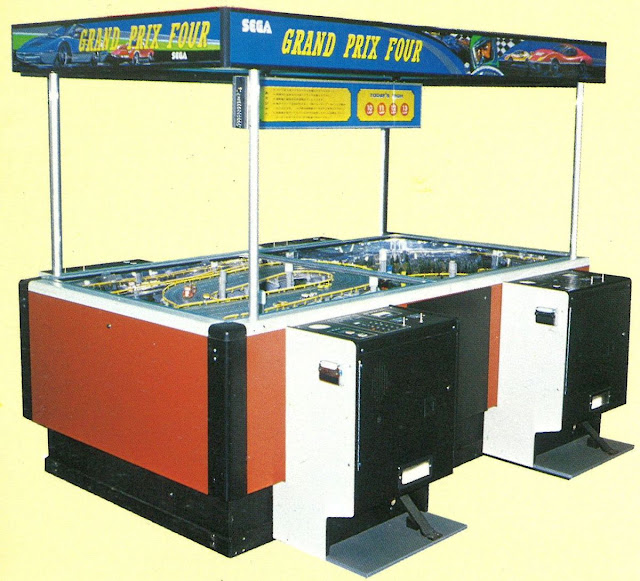
Grand Prix Four is a large medal game that was developed and built by Sega but never made it to full production, despite being exhibited widely in 1978. It could apparently be played as a medal game or as a regular amusement machine.
Four players controlled slot cars racing around the track. There are five lanes, with the 5th being for a rescue vehicle.
Game Machine 1978-07-15
English translation: (edited by tweakbod)
Game Machine No. 100 - Jul.15, 1978 (page 7) Newly Produced Grand Prix Four This Year's Sega New Product Exhibition
Sega Enterprises Co., Ltd.’s (Headquarters: 1-2-12 Haneda, Ota-ku, Tokyo, ☎ 742-3171, President Rosen) annual new product exhibition event was an enthusiastic affair with many invited guests at both the Tokyo and Osaka venues.
Movie Tie-in with Star Ship
Although a little later than usual, this year's event was held at the Hotel Pacific in Tokyo on June 27th and at the Royal Hotel in Osaka on June 30th, with President Rosen in attendance. Leading companies from all over Japan attended each of these events, and the new product presentations were lively.
The four-player medal game machine Grand Prix Four, the main game to be announced this time, was placed in the center of the exhibition hall, along with new TV game machines, flippers, Rock-Ola's latest juke 474, and the large screen TV project Sega Vision.
Grand Prix Four is a miniature car racer that pays out medals when it completes a specified number of laps on the course in a specified time. It is about the same size as a Harness Race, and the action of the rescue vehicle to save a car from an off-course accident is a masterpiece. The course is generally elaborate, with a railroad crossing and other features, but it is all done by electromechanical devices.
As for TV game machines, the company has high expectations for the space game Space Ship, the company's newly developed base attack game Secret Base, and the driving games Top Runner and Pro Racer. Among the flippers, the latest in the company's CPU series, Knockout Blow, the new Williams Lucky Seven, Hot Tip, and Stern's Stingray are attracting attention. . The only table type exhibited was the company's SuperBowl T II TV game machine. It was also emphasized that the company's four-player gun game machine, Amazonian, had been thoroughly improved.
At the reception that started at 6:00 pm, Vice President Duane Blough gave a speech (translated into Japanese by Mr. Shinohara), expressing his expectations for the company's Space Ship, which will be released simultaneously with the Star Wars movie, and made a presentation to introduce the products on display. Of these, the most noteworthy was the import trend of European and American flippers, and the company announced that it would be supplying the product as an agent of not only Williams, but also Stern of the U.S. and Interflip of Spain.
At the reception, there was a lottery with a special prize of one Sega Vision and ten sets of prize-winning Star Wars admission tickets. The venue was filled with excitement when a Sega Vision was presented to Mr. Sato of Tokai Amusement Co., Ltd. at the Tokyo venue and to Mr. Nakui of Taiko Bussan Co., Ltd.
[photo captions] President Rosen Vice President Blough
Top left: The upper and middle photos are at the Tokyo venue Bottom left: The photo below is from the Osaka venue
The "Star Ship" in the title appears to be a typo, where they crossed Space Ship with Star Wars by accident.
Grand Prix Four Finally on sale from Sega Minicar race turned into a medal game machine
Sega Enterprises Co., Ltd. (Head office: 1-2-12, 74213271 Haneda, Ota-ku, Tokyo, President: Rosen) is finally releasing the four-player medal game machine "Grand Prix Four". The player operates the accelerator to drive a minicar around a set circuit course, and if the minicar runs as many laps as possible within the time limit, medals are paid out if the number of laps is more than a certain number. If the car spins out at a corner and becomes unable to run, a rescue vehicle must be called. There is also a railroad crossing in the middle of the course, and a barrier is lowered every time a train passes, but if the car hits the barrier, the number of laps it has run up to that point becomes zero. The standard model has two ways, a medal slot and a 100-yen coin slot, and either one pays out medals (for replays) depending on the number of laps (100 yen is converted to six medals). A separate compact is available.
1978 AMOA - I think this image is from Replay magazine
Kansai: I'll add a little about the Grand Prix Four, as I was obsessed with AFX. Around 1980-82, Tommy acquired the sales rights in Japan for slot racing from an American company called Aurora, and released it as Tommy/Aurora AFX. Aurora released additional models with improved specifications, but in Japan, the basic one was called the "Magna Car," and what Aurora called the "G-PLUS" was sold as the "Super Magna Car." There was also a third chassis called the "Special Magna Car," and in the catalog on the first page of the "Tuning Manual" at the time, there was also a fourth chassis called the "High Super Magna Car," which I believe was probably a new chassis with magnets added that was released in Japan during the F1 boom.
Kansai: From the left, "Dodge Charger Stocker", "Corvette", "Mercury Stocker", and from the catalog that came with the Magna Car I bought, "Chevrolet Stocker". As far as I know, I couldn't find the red "rescue car" in the middle in the AFX catalog.
I think I operated it back then, but when I pressed the button, the yellow bar at the base of the rear of the car would open up in a fan shape from the front of the rescue car to the rear.
However, I don't remember how the rescue car saved cars that couldn't run.
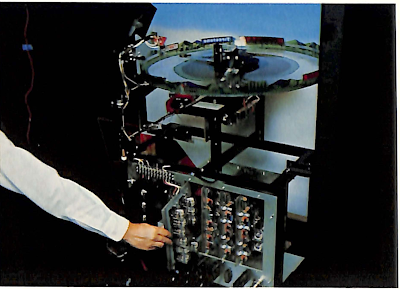
F-1 was a very successful electromechanical arcade machine. It was sold in two editions. Above is the small version, sometimes referred to as Deluxe. Below is referred to as the Custom model in the Japanese flyers, and as Large in the English ones.
F-1 [カスタム] (F-1 [Custom]) by ナムコ (Namco)
The following excerpts from Game Machine were transcribed and prepared by user tweakbod:
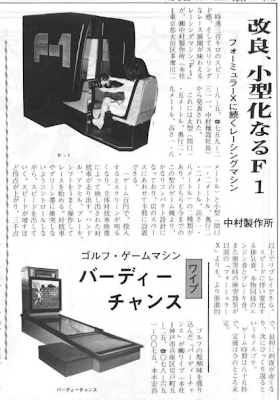
Improved, scaled down F-1 Racing machine following Formula X Nakamura Seisakusho
Nakamura Seisakusho Co., Ltd. (Head office: 2-8-15, Tamagawa, Ota-ku, Tokyo, 759-2311, President Masaya Nakamura) has announced the racing ☎ machine F-1, which is a must-see game that offers the thrilling experience of racing at the speed of 300 km/h.
There are two types: large (width 1.5 meters, depth 2.9 meters, height 1.8 meters) and small (width 1.2 meters, depth 2.2 meters, height 1.8 meters). Both are considerably more compact than previous game machines of this type, and can be easily installed to suit the space available at the venue.
When you insert 100 yen for 1 game the screen lights up and a rival car starts to drive on the screen by means of a projected stereoscopic image. Start the race by skillfully operating the steering wheel, accelerator, brakes, and shifter. The player must increase speed while maintaining control to avoid colliding with opposing vehicles or the green zone. The higher the speed, the higher the score, and you can replay the game with more than 3,000 points.
The exhaust sound changes with speed, and the engine and braking sounds are just like the real thing. In addition, the collision effect at the moment of impact is even more dramatic than in the previous Formula X, with the screen first turning red, and then overturning in a frightful way.
The game time is 85 seconds. The list price has not yet been determined.
F-1 World Championship Preliminaries with Top Racers
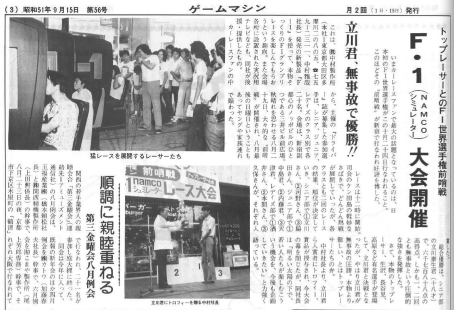
F-1 (NAMCO Simulator) Tournament Held
One of the hottest topics among car racing fans today is that Japan's first F1 World Championship will be held on October 24th. The “preliminaries” of the championship were recently held in Shinjuku and were well received.
Tachikawa-kun won the championship without any accidents !!
The idea of the event was to let visitors enjoy a realistic F1 Grand Prix race using the new F-1 product released by Nakamura Seisakusho Co., Ltd. (Headquarters = 2-8-5, Tamagawa, Ota-ku, Tokyo, 759-2311, President Masaya ☎ Nakamura). The company also sponsored the event and provided the live-action TVs and other equipment set up throughout the venue.
Driver magazine, the organizer of the event, recruited participants from among car racing fans with 20 each in the Senior, Junior, and Ladies' classes. The venue was the plaza in front of the Mitsui Building, one of the tallest buildings in the Shinjuku city subcenter. On August 29th, a beautiful autumn day, a large scale “preliminaries” were held, and since it was the last Sunday in August, the event was crowded with young people and families.
The races started at noon, and the heated battle unfolded rapidly with the witty judgement of MC Ken Tajima. The rankings were determined by two races in each class, and the prize winners were: Senior Division; Tachikawa-san, Kono-san, Wakita-san ① ② ③ Junior Division; Nakajima-kun, Naito-kun, Tianjin-kun ① ② ③ Ladies' Division; Sakai-san, Homma-san, and Kubo-san ① ② ③ The overall winner was Yasuo Tachikawa (18 years old) from the senior division, with a high score of 6,788 points. Moreover, he demonstrated overwhelming strength, having won both the first and second rounds without an accident.
Well, the real top racers, famous drivers such as Ikusawa, Hasemi, and Takahara appeared on stage and had a decisive battle with Tachikawa-kun, but in the end, Tachikawa-kun won hands down without an accident. The top racers say it's harder than the real thing.
President Nakamura presented trophies and prizes to Tachikawa-kun and the other winners, bringing the competition to a close. President Nakamura stated emphatically, “We would like to continue to plan opportunities like this for young people to enjoy themselves under the bright sun.”
[photo captions] [top] A fierce race unfolds for the racers [bottom] President Nakamura presenting the trophy to Tachikawa-kun
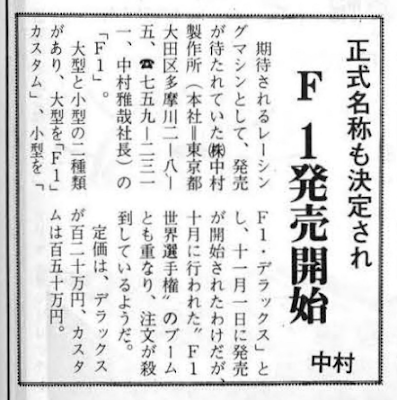
The official names have been decided and F-1 is now on sale Nakamura
F-1 of Nakamura Seisakusho Co., Ltd. (Headquarters = 2-8-5 Tamagawa, Ota ku, Tokyo, 759-2331, President Masaya Nakamura) is a highly anticipated ☎ racing machine which has been waiting for release.
There are two types, large and small, with the large one being F-1 Custom and the small one being F-1 Deluxe, which was released on November 1st, and orders seem to be flooding in, coinciding with the boom of the F-1 World Championship which was held in October. The list price is 1,200,000 yen for the Deluxe and 1,500,000 yen for the Custom.
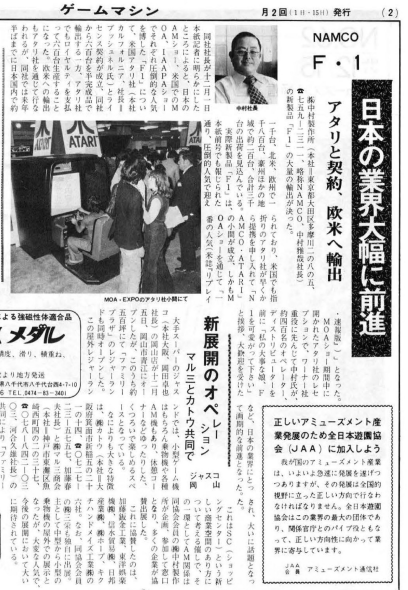
Significant progress in the Japanese industry Contract with Atari, exports to Europe and America
Nakamura Seisakusho Co., Ltd. (head office = 2-8-5, Tamagawa, Ota-ku, Tokyo, 759-2311, abbreviation NAMCO, ☎ President: Masaya Nakamura) has decided to export large quantities of its new product F-1.
According to the company president's announcement to this newspaper on December 1st, a license agreement was concluded with Atari, Inc. of the U.S. (Headquarters California, President: Bushnell) for F-1, which enjoyed overwhelming popularity at the AM Show in Japan and the MOA and IAAPA shows in the U.S., respectively. The company would export six hundred units in semi-finished form, while Atari would also pay royalties to produce six hundred units. Exports to Europe and the United States will be made through Atari, and the company expects to ship approximately 1,000 units in Japan, 1,800 units in North America and Europe, and 200 units in Australia and other regions by the middle of next year, for a total of 3,000 units.
In fact, as reported in the previous issue of this paper, the new F-1 has been overwhelmingly popular, and Atari, one of the most prominent companies in the U.S., made an early request for a tie-up, resulting in the establishment of the NAMCO ATARI booth, which was “the most popular (according to the Replay Bulletin)” throughout the MOA show.
At an Atari reception held during the MOA Show, Mr. Nakamura, preceded by a Warner executive, addressed approximately 400 operators and distributors, saying, “Please take good care of my precious daughter, F-1,” which received a rousing welcome. It was an unprecedented step forward for the Japanese industry.
[photo captions] President Nakamura Atari’s booth at the MOA - EXPO
ただこれらは今までのところ、この業界で公開された争い、とはなかな かなり難いと言われる。そういう意味で、今回の問題のなりゆきが注目さ れるところである。 また同社長は従来から AM ショーの運営の中でも、コピー問題について 訴えてきており、しかも全日本遊園協会(JAA)副会長という立場から、 JAA との関係でも新たな発展がありうる、と予想されている。
[photo caption]
中村社長
Translation:
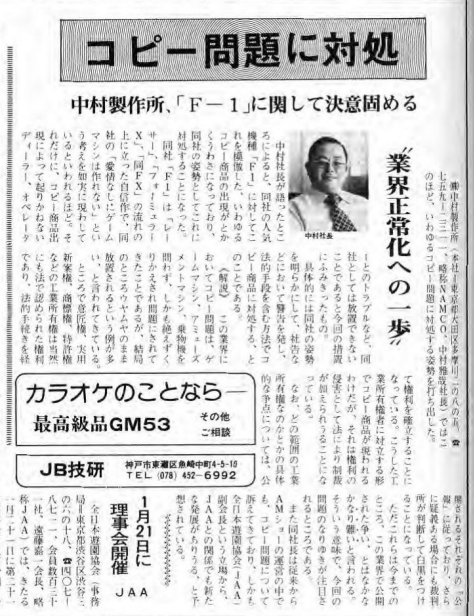
Addressing the Copying Issue Nakamura Seisakusho hardens its resolve regarding F-1
Nakamura Seisakusho Co., Ltd. (Head office: 2-8-5, Tamagawa 2-8-5, Ota-ku, Tokyo, 759-2311, abbreviated as NAMCO, President Masaya Nakamura) has ☎ recently announced its stance on dealing with the so-called copy problem.
“A step toward the normalization of the industry” According to President Nakamura, there have been rumors about the appearance of so-called copy products imitating the company's popular F1 model, and the company has decided to take action. The company's F1 is a work of art that the creator has confidence in that builds on the success of Racer, Formula X, and Formula FX, and is said to truly express the company's belief that you can't make a game machine without love. Therefore, the company decided to take this measure because it could not afford to neglect the problems with dealers and operators that could occur as a result of the appearance of counterfeit products.
Specifically, the company will make its position clear, issue warnings in company announcements, etc., and take other measures, including legal action, to deal with the problem of copied products.
《Explanation》 In this industry, the problem of copying has been raised repeatedly, regardless of whether it is a game machine, an amusement machine, or a ride, but in the end, there are many cases where the copying problem is left unresolved.
Incidentally, industrial property rights such as design rights, utility model rights, trademark rights, and patent rights are, of course, rights recognized by law and are established through legal procedures. When a copied product appears in opposition to such industrial property rights, it is considered an infringement of those rights and can be sanctioned by law.
In addition, regarding the specific issues such as the scope of industrial property rights, it is in accordance with each published "public bulletin," and even if there is any doubt, the court will make a judgment to determine whether the matter is black or white.
However, it is said that so far, it has been difficult to make this an open dispute in the industry. In this sense, it will be interesting to see how this issue plays out.
In addition, as a traditional member of the AM Show management, the company's president has long complained about the copy issue, and from his position as vice president of the Japan Amusement Park Association (JAA), new developments in the relationship with the JAA are anticipated.
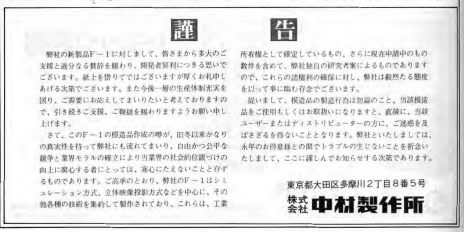
We are very pleased to receive your generous support and praise for our new product, F-1, and we are proud to be its developer. Although this is only on paper, we would like to express our deepest gratitude. In addition, we will continue to strive for further enhancement of our production system to meet your demand, and we would like to ask for your continued support and encouragement.
Rumors of the creation of a counterfeit F-1 have been circulating to our company with considerable veracity since last winter, and it is a matter of deep concern to those of us who are striving to improve the social standing of our industry through free and fair competition and the establishment of industry morals. As you are aware, our F-1 is manufactured by integrating various technologies, including simulation methods, stereoscopic image projection methods, etc. We are determined to take a firm attitude toward securing these rights, as they are the result of our own research and development, including those that have been confirmed as industrial property rights and several others that are currently under application.
Therefore, the manufacture of counterfeit products, as well as the use or handling of such counterfeit products, will directly cause inconvenience to the users or distributors concerned.
We would like to express our sincere hope that this will not cause any trouble with our long-time customers.
2-8-5 Tamagawa, Ota-ku, Tokyo Nakamura Seisakusho Co., Ltd.
For some time there has been a dispute between the two companies listed below, regarding a driving game machine that Taito Corporation recently purchased from another company, its shape and appearance being similar to the driving game machine F-1 manufactured and sold by Namco Limited, but the dispute has been resolved amicably through discussions between the two companies.
In resolving the above, both companies regret that there is a tendency in this industry to simply copy, which is a practice that calls into question the decency of businesses, and have agreed to make further efforts together to rectify the situation in the future for the sake of the industry's credibility and authority.
We would like to express our deepest apologies for any inconvenience and concern this dispute may have caused to the industry and would like to report the amicable settlement of the dispute and ask for your continued patronage in the future.
Thank you very much for your continued patronage. We would like to thank you again for the large number of purchases and favorable response to our F-1 product.
With regard to the problem of Zed Machine, which has caused some concerns to everyone, a provisional injunction order has already been issued by the court against a certain company that manufactured it, and of the companies that handled the Zed Machine, an amicable settlement has been reached with Taito as shown in the letter of greeting to the left. Other related companies are also urged to resolve this issue as soon as possible in order to establish order in the industry and to protect their rights in accordance with the spirit of this document. Furthermore, we would like to ask all of you who are currently using Zed Machine to contact us as soon as possible in order to resolve the issue amicably.
300 km/h Car Race The Powerful Zed Machine Ushio Sangyo
The driving game machine Zed Machine of Ushio Sangyo Co., Ltd. (Head office = 9-1, Nakamaru-cho, Itabashi-ku, Tokyo, 974-4331, President Futao ☎ Ogasawara), is said to have many problems.
This machine, which is constantly rumored since its release to be a copy of F-1 (made by Namco Limited), has a speed of 300 km/h, just like the real thing. By operating the steering wheel, accelerator and brake pedals, the driver overtakes opposing cars while increasing speed, and the higher the speed, the higher the score. If the driver makes a mistake in steering or braking, a shocking accident scene is shown on the screen.
The realistic sound of the engine and brakes adds to the intensity of the game. The list price is unknown.
1976 F-1 by ナムコ (Namco)
If you encounter one of these machines, check the embossing on the black chasis:
note the "ZM" embossed into the siding.
Namco took legal action and eventually resolved the lawsuit, demanding compliance from everyone who sold it. Most notably, Taito was apparently guilty of selling the bootleg Z Machine when Namco was unable to produce enough F-1 machines to sell.
Indisputably one of the coolest cabinet ever made at the time, the F-Type Indy 500 made a huge splash at Expo '70 and began the era of deluxe immersive driving cabinets. (note: I could be wrong, but I think this is fair. If you know of an early cabinet in this style please let me know)
Indy 500 was first released in 1969 with the M-Type cabinet. The W-type and F-type cabinets came out in 1970 and continued to be sold for a number of years.
specifications given in a Kasco flyer
Expo '70
at Expo '70 AJAP 1970-05
at the 9th annual Amusement show published 1970-11
The Kasco brand was alive an well back then, but for some reason I do not see any "Kasco" markings on this or any other Indy 500 cabinets.
The M-Type cabinet came first in 1968, then Kansai Seiki made the W-type (wood) with a fornica cabinet for exports.
This new cabinet was still sold domestically, I assume to keep competition vs the hot new machine Racer. The pedal is now recessed into the cabinet, the front dashboard has a large bulbous appearance, and the marquee is built into cabinet.
One aspect North American collectors often overlook is the proximity of Australia to Japan. They were an obvious export market. Here is an excerpt from an Australian flyer extoling some of the technical innovation.
excerpt from Australian flyer.
Indy 500 W-Type in an arcade in Japan this photo is from /19741973 at minimum because the arcade has air hockey tables.
Indy 500 W-Type in a 1972 photograph (center game) published in the Taito 40th anniversary book
Indy 500 was a revolutionary game. It first appeared in 1968 (according to the book ミニドライブ大百科,) and we see it in the 1969 machine directory.
1969 machine directory
It was made in a few colours, including a deep orange.
One note is that the "Kasco" brand name does not seem to appear on the Indy 500 machines.
The original version here is called M型 (M Type) because the cabinet is made from metal. The W型 (W Type) model was made of wood. It was made in response to enthusiastic international orders. The marquee was built into the cabinet on the W type. Here is a great comparison of the physical measurements:
The M-type cabinets were still advertised overseas, but it was the W cabinet made for exports in mind. Here is an English language flyer for the original M-Type model.
Indy 500 M-type at Expo '70
Indy 500 M-Type would be followed in 1969 by the W-Type and in 1970 by the F-Type model.
In 1969 the USA company seemingly Chicago Coin copied Indy 500 for their game Speedway.
1969 Speedway by Chicago Coin
1969 Speedway by Chicago Coin
excerpt from the 20th Century Youth Culture Clip Magazine
The above excerpt claims that Speedway was licensed from Kansai Seiki, but it also says Speedway was 1970, so I am unsure how authoritative that is. I have heard other people say they assume it was licensed, but I would like to see a more definitive source.
Machine translation: Chicago Coin released the licensed products "Speedway" by Kansai Seiki Seisakusho, "Racer" by Nakamura Seisakusho, and "Super Road Seven" by Taito Boeki.