Name: Red Gun - レッド・ガン
Year: 1963
Company: 関西精機 (Kansai Seiki)
Red Gun was Kansai Seiki's first of 5 gun games released in the 1960s which all share the same cabinet shape.
From an article in Amusement Journal on Kansai Seiki history:
 |
| Amusement Journal 2018-08 |
Transcription:
そして昭和37年以降、関西精機製作所もガンゲームを開発・発売していくようになる。
同社はまずジャングルをテーマとし、製品名通り真っ赤なガンを筐体に備え付けた「レッドガン」を開発し、続いて水中銃を備え付けた海がテーマの「マリーンガン」を、さらには鳥打ちをテーマにした「バーディガン」を開発した。
Machine translation:
From 1962 onwards, Kansai Seiki Seisakusho also began developing and releasing gun games.
The company first developed the "Red Gun," which had a jungle theme and had a bright red gun in its casing, as the name suggests, followed by the sea-themed "Marine Gun," which was equipped with an underwater gun, and then a bird-catching gun. Developed a themed "Birdie Gun".
That article says they began development of gun games in 1962, but in the Mini Drive Encyclopedia, we are told that Red Gun was released in 1963:
Transcription:
この時期に、「デールガン」の仕組みを使った国産のガンゲームも作られている。1961年には「セガ」ブランドとしては、初のガンゲームと言える「ジャングルガン」(製造は日本娯楽物産)が発売され、関西精機製作所も1963年に「レッドガン」を開発、さらに「マリーンガン」「バーディーガン」などを次々に発売している。
Machine translation:
During this period, a domestic gun game using the "Dale Gun" mechanism was also created. In 1961, the first gun game under the SEGA brand, ``Jungle Gun'' (manufactured by Nippon Kyoto Bussan), was released, and Kansai Seiki Seisakusho also developed ``Red Gun'' in 1963, followed by ``Marine Gun.'' and “Birdie Gun” have been released one after another.
The Kansai Seiki gun games of the 1960s all use a cabinet that appears to be based on a German machine from 1956:
 |
1956 Schießautomat by Wiegandt
Automatenmarkt 1957/02
via antik-automaten.de (archive)
(I am told it was first shown in 1956, even though this article is 1957) |
The only other photo I could find, thanks to user Tonmaster:
The article says the German game measures (cm) 175 tall x 60 wide x 90 deep. This is much smaller than similar games from the USA.
From a 1956 Mike Munves catalogue, you can see numerous gun games with a similar protruding pedestal...
 |
| 1956 Mike Munves catalogue excerpt |
The only games that come close to what we've been looking at are the Genco ones:
 |
| note how the back cabinet angles forward, the gap between the main cab and the protrusion. |
We know these Genco gun games existed in Japan in 1963, thanks to the NHK documentary.
The important thing to note in the above advertisement is that the game is 29.5 inches, that is 75 cm.
In this auction, the machine is listed as 31" across, or 78.8 cm.
The size is important, because the Kansai Seiki gun games are listed as 56cm wide:
 |
| from a Kansai Seiki flyer, around 1968 |
While the Genco gun games were a major stylistic influence, I do not think Kansai Seiki modeled their cabinets after Genco. The German gun game is 175 tall x 60 wide x 90 deep, much more in line with what the Kansai Seiki catalogue shows.
Now let us compare details of the head. They both share the same soft borders around the marquee, and share nearly identical sizes/proportions. One thing to note is that the border between the marquee and the lower playfield is thinner in the German version.
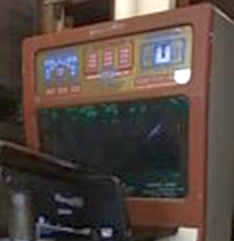 |
| (image flipped for demonstration purposes) |
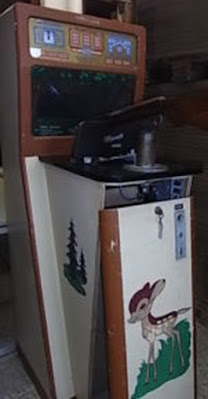
In the English-speaking press, this German game was referred to as 'Bambi', obviously so for the graphic on the front similar to Disney's Bambi.
In 1958, Wales (UK) company Automaten Distributors Ltd of Llandudno licensed the game and produced a version referred to as "Electronic Shooter".
In the German press, this game was referred to as "Super Sharp Electronic Shooter". There is no marquee with the name on the game, and I was unable to find a reference using "Super Sharp" in the English press.
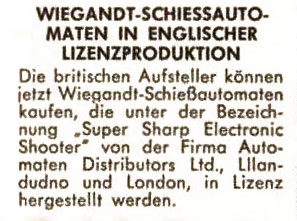 |
Der Automatenmarkt 1959-03
(courtesy Tonmaster) |
Transcription:
WIEGANDT-SCHIESSAUTOMATEN IN ENGLISCHER LIZENZPRODUKTION
Die britischen Aufsteller können jetzt Wiegandt-Schießautomaten kaufen, die unter der Bezeich- nung Super Sharp Electronic Shooter von der Firma Automaten Distributors Ltd., Lilandudno und London, in Lizenz hergestellt werden.
Machine translation:
WIEGANDT SHOOTING MACHINES PRODUCTION UNDER LICENSE IN THE UK
British operators can now purchase Wiegandt shooting machines manufactured under license under the name Super Sharp Electronic Shooter by Automaten Distributors Ltd., Lilandudno and London.
Electronic Shooter uses bulbs in the marquee area for the points and shots fired. On the Kansai Seiki games, score is tabulated via reels, and the shots are tracked by lights at the bottom of the shooting area. I do not know if the Japanese games have a timer like the German/UK one.
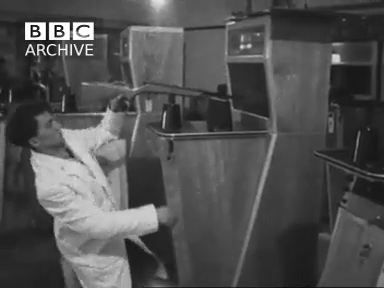
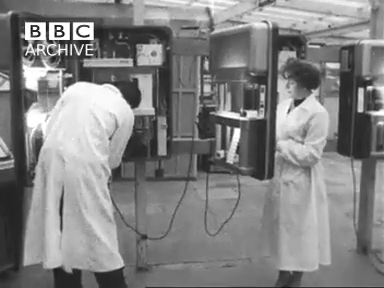
I received a note from user Tonmaster about these games built in Wales. "This film shows the licensed production of the Sharp Shoot, the Tonmaster and the Diplomat B jukebox at Automaten Distributors in Llandudno, Wales."
This video was listed as being from 1958-12-18
Screenshots from the video:
 |
| did one version use 3D painted trees in the diorama? |
 |
Looking down into the cab, these targets would be seen properly reflected in the mirror.
1958 Electronic Shooter built by Automaten Distributors Ltd of Llandudno, Wales
source: user Tonmaster |
I do not know if any variations of the backglass exist, but they look hand-painted and so might have subtle differences.
 |
| 1956 German backglass |
 |
| 1958 Wales version |
I do not have proof of this, but I believe the Kansai Seiki gun games, or at least the cabinet design, were based off German machines. Since they share the same cabinet design, this would include all 5 of the Kansai Seiki gun games from the 1960s.
 |
from Amusement Journal 2018-08
1963 Red Gun - レッド・ガン by 関西精機 (Kansai Seiki)
~1965 Marine Gun - マリーンガン by 関西精機 (Kansai Seiki)
~1967 Birdie Gun - バーディガン (Bird gun) by 関西精機 (Kansai Seiki) |
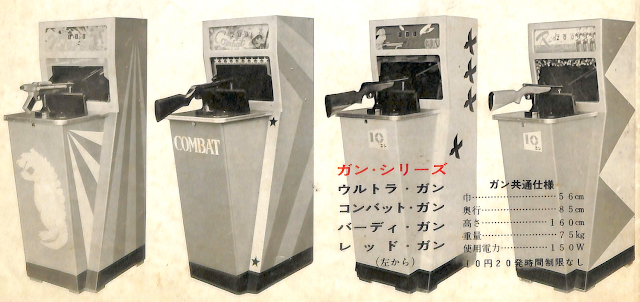 |
~1968 ウルトラガン (Ultra gun) by 関西精機 (Kansai Seiki)
~1968 Combat - コンバットガン (Combat Gun) by 関西精機 (Kansai Seiki)
~1967 Birdie Gun - バーディガン (Bird gun) by 関西精機 (Kansai Seiki)
1963 Red Gun - レッド・ガン by 関西精機 (Kansai Seiki)
|
More pictures:
 |
| Amusement 1973-02 |
 |
| Amusement 1976-06 |