Showing posts with label steering wheel. Show all posts

Thursday, 18 June 2026

1970 Super Road 7 - スーパーロードセブン by 太東貿易 (Taito Trading)


Name: Super Road 7 - スーパーロードセブン
Year: 1970
Company:  太東貿易 (Taito Trading)


1972 machine directory entry

Taito 40th anniversary book entry showing 1970


English (export) flyer

English language ad seen in Cash Box.  (I lost the reference)


Photos of the marquee from an auction.  A Game Mate sticker was placed over the Taito logo.


The Japan Game Museum channel has a number of short videos that showcase the machine.


Friday, 12 May 2023

1970 Indy 500 [F-type] - インディ500 F型 by 関西精機 (Kansai Seiki)

Name: Indy 500 [F-type] - インディ500 F型
Year: 1970
Company: 関西精機 (Kansai Seiki)

Indisputably one of the coolest cabinet ever made at the time, the F-Type Indy 500 made a huge splash at Expo '70 and began the era of deluxe immersive driving cabinets.  (note: I could be wrong, but I think this is fair.  If you know of an early cabinet in this style please let me know)

Indy 500 was first released in 1969 with the M-Type cabinet.  The W-type and F-type cabinets came out in 1970 and continued to be sold for a number of years.


specifications given in a Kasco flyer


Expo '70

at Expo '70
AJAP 1970-05

at the 9th annual Amusement show
published 1970-11

The Kasco brand was alive an well back then, but for some reason I do not see any "Kasco" markings on this or any other Indy 500 cabinets.


1969 Indy 500 [W-type] - インディ500 [W型] by 関西精機製作所 (Kansai Seiki)

Name: Indy 500 [W-type] - インディ500 [W型]
Year: 1969
Company: 関西精機製作所 (Kansai Seiki)


The M-Type cabinet came first in 1968, then Kansai Seiki made the W-type (wood)  with a fornica cabinet for exports.


This new cabinet was still sold domestically, I assume to keep competition vs the hot new machine Racer.  The pedal is now recessed into the cabinet, the front dashboard has a large bulbous appearance, and the marquee is built into cabinet.

This design would be copied (converted from?) by Oriental Kogyo a year later for their machine: 1970 Monte Carlo - モンテ カルロラリー (Monte Carlo Rally) by オリエンタル興業 (Oriental Kogyo)


One aspect North American collectors often overlook is the proximity of Australia to Japan.  They were an obvious export market.  Here is an excerpt from an Australian flyer extoling some of the technical innovation.

excerpt from Australian flyer.


Indy 500 W-Type in an arcade in Japan
this photo is from /19741973 at minimum because the arcade has air hockey tables.

Indy 500 W-Type in a 1972 photograph (center game)
published in the Taito 40th anniversary book


1968 Indy 500 [M-type] - インディ500 [M型] by 関西精機 (Kansai Seiki)


Name: Indy 500 [M-type] - インディ500 [M型]
Year: 1968
Company: 関西精機 (Kansai Seiki)


Indy 500 was a revolutionary game.  It first appeared in 1968 (according to the book ミニドライブ大百科,) and we see it in the 1969 machine directory.

1969 machine directory


It was made in a few colours, including a deep orange.

One note is that the "Kasco" brand name does not seem to appear on the Indy 500 machines.

The original version here is called M型 (M Type) because the cabinet is made from metal.  The W型 (W Type) model was made of wood.  It was made in response to enthusiastic international orders.  The marquee was built into the cabinet on the W type.  Here is a great comparison of the physical measurements:


The M-type cabinets were still advertised overseas, but it was the W cabinet made for exports in mind.  Here is an English language flyer for the original M-Type model.


Indy 500 M-type at Expo '70

Indy 500 M-Type would be followed in 1969 by the W-Type and in 1970 by the F-Type model.

In 1969 the USA company seemingly Chicago Coin copied Indy 500 for their game Speedway.

1969 Speedway by Chicago Coin

1969 Speedway by Chicago Coin


excerpt from the 20th Century Youth Culture Clip Magazine
 
The above excerpt claims that Speedway was licensed from Kansai Seiki, but it also says Speedway was 1970, so I am unsure how authoritative that is.  I have heard other people say they assume it was licensed, but I would like to see a more definitive source.
Transcription: シカゴコイン社が関西精機製作所の許諾品『スピードウェイ』、中村製作所『レーサー』、太東貿易『スーパーロードセブン』を発表
Machine translation: Chicago Coin released the licensed products "Speedway" by Kansai Seiki Seisakusho, "Racer" by Nakamura Seisakusho, and "Super Road Seven" by Taito Boeki.


Saturday, 25 March 2023

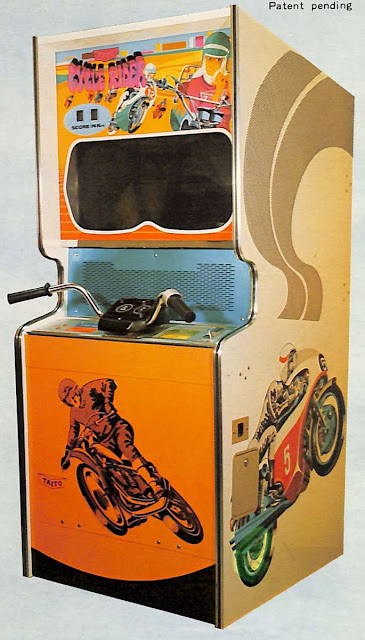
1970 Cycle Rider - サイクルライダー by 太東 (Taito)


Name: Cycle Rider - サイクルライダー
Year: 1970
Company: 太東 (Taito)


Cycle Rider is fairly obscure but there is evidence of it having been exported outside Japan.


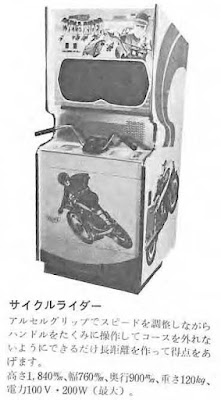
We can find an entry for it in the 1972 Machine directory:


One mystery around Cycle Rider is the appearance of an exact copy but with a wildly psychedelic paint job.  This photo, which features a machine by Oriental Kogyo that is an obvious repaint of another company's machine (please see: Phantom-F-108 [Phantom II-108] by オリエンタル興業 (Oriental Kogyo)) is extremely curious and it makes me think that this painted Cycle Rider is the work of Oriental Kogyo as well:

unknown game [same cabinet design as Cycle Rider - サイクルライダー by 太東 (Taito)] by unknown

Every detail of that cabinet we can see appears to be exact to Cycle Rider, suggesting to me it was just repainted in a manner similar to Phantom-F-108.

1970 Monte Carlo - モンテ カルロラリー (Monte Carlo Rally) by オリエンタル興業 (Oriental Kogyo)


Name: Monte Carlo - モンテ カルロラリー (Monte Carlo Rally)
Year: 1970 
Company: オリエンタル興業 (Oriental Kogyo)


Monte Carlo was seen at the 1970 amusement show:
AJAP 1970-11

Monte Carlo appears to be a near exact copy of  a version of Indy 500 by Kansai Seiki.
Indy 500 [W-type] - インディ500 [W型] by 関西精機製作所 (Kansai Seiki Seisakusho)

While Indy 500 was first released in 1968, 1969 is the earliest appearance of this style of cabinet, called W-type.  This was the export model.  Did Oriental Kogyo purchase a bunch and then redo the marquee and some of the cabinet details?

The vertical lines are missing on the Oriental Kogyo version, but the foot pedal area seems almost exactly the same.
The side art checkered flag decal was replaced with a similar one saying Monte Carlo, but the car decal is gone.
The marquee looks somewhat similar, and all of the displays and location seem to line up. 

There is a sticker on the Oriental Kogyo cabinet, maybe that's a track map?  But it does not appear on the Kansai Seiki original.  It says "Monte Carlo Grand Prix" at the top and has a map of the course which I think it is safe to assume does not represent the gameplay.

same map shape

1970 Wild Cycle - ワイルドサイ クル [import, 1970] by Allied Leisure & オリエンタル興業 (Oriental Kogyo)


Name: Wild Cycle - ワイルドサイ クル
Year: 1970, imported [?] 1970
Company: Allied Leisure & オリエンタル興業 (Oriental Kogyo)


Wild Cycle was released by Allied Leisure (USA) in 1970.  By the end of the year, it appeared in Japan as a machine being sold by Oriental Kogyo

AJAP 1970-11

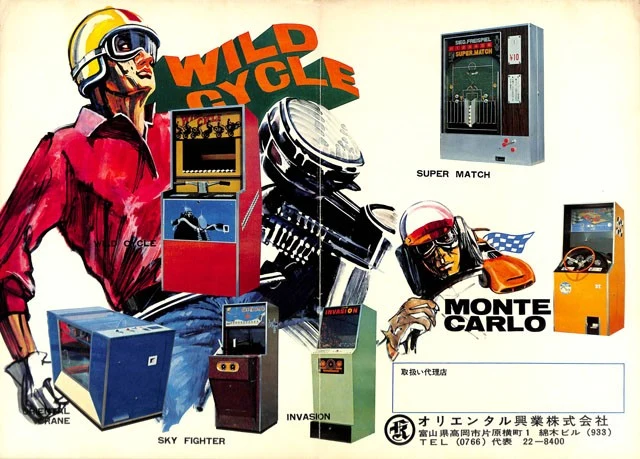
Oriental Kogyo flyer shared by nazox2016


Luckily for us, pindude152 purchased a NIB Wild Cycle by Allied Leisure and we can see it first coming out of the box.  The whole series of posts, or go to the first unboxing post.

image from pindude152

Notice anything different?  Well yes, a whole lot is different here, actually!  The Japanese version is VERY different, almost to the point where I suspect whether the Oriental Kogyo machine was simply INSPIRED by the Allied Leisure machine.

But note: this Japanese version came out the SAME YEAR of the Allied Leisure one.  That's a pretty fast turnaround time to steal an idea or even import and modify a machine.


From the pinrepair page (archive) on Wild Cycle, the side of the cab is blue, and an entirely different shape


The handle bars are entirely different.


The Japanese one also has those odd white squares at the bottom of the window?


The Allied Leisure one (top) cabinet art, and then the Japanese one is an obviously repainted copy.


And then the marquee art?  On the Allied Leisure copy we have motorcycles that look like they are accelerating off a jump, but the Oriental Kogyo one looks like it's a parade of bikers all "popping a wheelie" simultaneously.


The Allied Leisure version also has that window in the upper right.

Can we safely assume that the Oriental Kogyo one is based on the Allied Leisure one, but not an import?  It is hard to say without further information.  I am going to leave this listed as an "import" for the time being.

a foreigners' guide to eremeka arcades - 外国人のためのエレメカアーケードゲームガイド: introduction & main page - 紹介&メインページ

eremeka search tool  // エレメカ検索ツール begin browsing at the beginning / 最初から閲覧を開始する begin browsing at 1960 / 1960年代から閲覧する begin browsing at 1970...