Bombing appears in the 1966 Senyo Kogyo catalogue. The only image is from a for-sale ad for the catalogue.
image from a for-sale ad for the 1966 Senyo Kogyo catalogue
2 helicopters, one red one white, are suspended from the ceiling of the game. They are attached on opposite sides of a rotating shaft. The gameplay appears to be that the player presses a button to drop a metal ball from the helicopter on to the playfield.
In this video from 長島温泉 (Nagashima Onsen) we can see Bombing being played at 10:44. The game center footage begins at 10:23 and runs to 10:59. It's mostly rides, but there is also a shooting gallery we only see the guns from, and a bowling alley. (does anyone know when this video is from?)
It's not a great angle, but we at least can see the ball dropping.
As always, if you have ANY more information or insights about the games discussed here, please leave a comment or send me an email (thetastates@gmail.com)
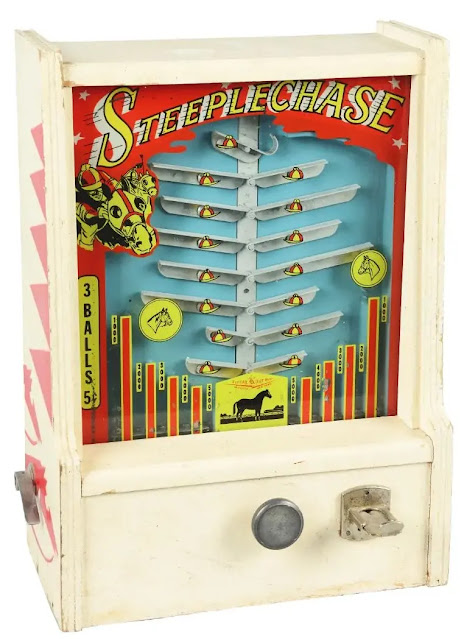
In 1968, the USA company Irving Kaye released the game Steeplechase.
1968 Steeplechase by Irving Kaye
Coin Box 1968-05-18
Daishogai seemingly utilizes some of the same hardware as Steeplecase, or is at least probably copied from it.
Steeplechase has a handle to shoot the ball up on the left side, Daishogai on the front. Daishogai has a singular goal to enter to win a prize, while Steeplechase gives you multiple balls to build a higher score for amusement's sake.
On Steeplechase, and on every other version of this style of game, the ball alternates direction on each platform.
Daishogai has two places where the ball travels down the same side, 2 levels in a row! This seems like a mistake in the design, but I also wonder if they had a shortage of some of the parts?
I do not think Steeplechase was a big seller. It would certainly be possible that some of their parts were purchased by Satomi, especially when we consider that Satomi seemingly has a history of purchasing parts of foreign games to build new games.
This ball path does not seem to be an error made for the flyer. In the 1973 photo above, we can see this odd ball path: Left, left, right, left, left, right, left, right.
A photo of the machine was taken from an auction in 2026:
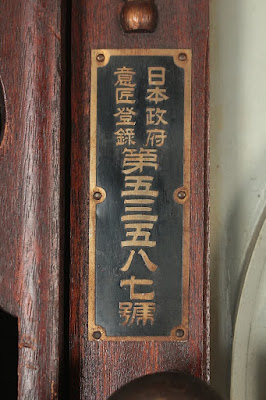
This is a candy-vending game machine. It came up for sale on YJA. (archive) This machine was written in the book コリントゲーム史 (History of the Corinthian Game) by Kazuo Sugiyama. He writes that it was first registered in 1931, and the book includes an advertisement that mentions it:
advertisement from 佐藤寛蔵商店 (Sato Kanzo Shoten) published 1932-07-04 in Tokyo Asahi Shimbun reproduced in History of the Corinthian Game
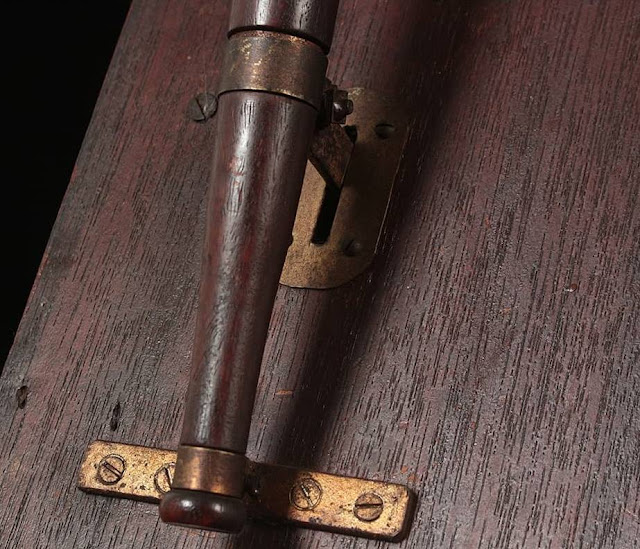
Instead of using a pachinko-style lever, this game uses a lever (that looks like a baseball bat!) on the right side of the machine to propel the ball in to play.
lever for shooting the ball
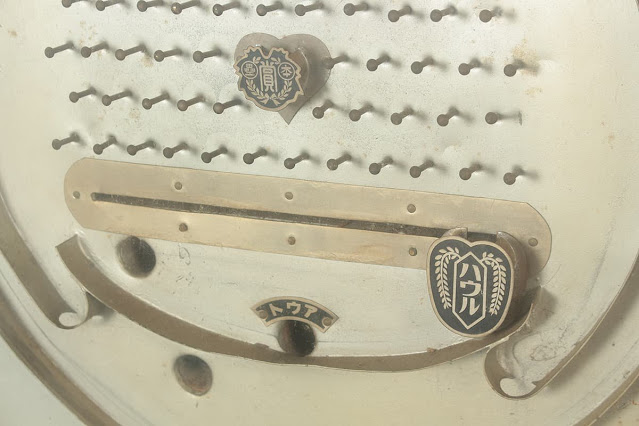
It appears that each of the 4 top cups are winners, that will reward the player with a candy.
一壘 = first base 二壘 = second base 三壘 = third base
On the left side is a knob to control the catcher mechanism. Catching the ball returns it to play in hopes of winning on the next shot.
本壘 = home base the catcher says ハウル (foul) bottom hole is アウト (out)
I had bid on this machine and wish I won it, but it was too expensive for me.
Here is a look at the bottom of the playfield. The hole on the left is what the catcher deposits a ball into. This aligns with "Kicker Catcher" machines designs that were quite popular in USA. The ball falls out of the hole down and to the right of it. On the right there are two holes by the kicker. I believe one gives you the ball when when you insert a coin. I believe the other hole releases the ball after winning a candy, so it could be fired again.
The inside of the machine, there is a track for the candy. All of the winning holes appear to converge, and I suspect that after the payout, your ball is returned to shoot again. In the 2nd part of this, you can see how the catcher is controlled by a belt attached to the side knob.
Arcade helicopter games really took off in the 1960s, but are traced back to the 1940s.. Let's take a look at the helicopter games that immediately preceded Sega's Helicopter.
Flying Games
Before the helicopter games, there were a few games that involved rotating an aircraft around a fixed point. The player would have to fly high and fast enough, and then bring in their plane for landings on desirable spots.
1941 Air Defense by C. R. Kirk & Co & International Mutoscope - via KLOV also on pinrepair
The story of helicopter games begins in Canada, where Peter Jacobs of Jaycopters Ltd begins work turning military helicopter training simulators into a ride.
At The World's Fair there were miniature versions of the Jaycopter to play with. We can see them in this advertisement, and in this photograph, the model versions. They all appear larger than the regular coinop one we would see later, but they were coin operated and would set the template for all future helicopter games. If anyone has any photographs of the coin-operated Jaycopter games at the World's Fair, please get in touch!
FB Video on the Jaycopter from The Games Room Company. Jaycopter at pinrepair. All online sources say the normally produced Jaycopter is from 1968, though I can't find any primary sources for that. But the patent for the arcade machine design was filed in 1967, so the dates do line up.
The first official trade magazine mention of Amusement Engineering's Helicopter Trainer was in 1967. Note the last line of this snippet:
1966-09-03 Coin Box
The patent was filed in 1965, one year after the Jaycopter and the coinop Jaycopters appeared at the 1964 World's Fair. R.L. Brown is probably the same Lt. Col. Richard F. Brown that is referred to in a subsequent 1968-03-09 article. (see lower on this page)
The game seems to have arrived in production June 1967:
1967-06-10 Coin Box
1967-07-08 Coin Box "Yes, we have the sensational HELICOPTER TRAINER"
1967-11-25 Coin Box
Midway
In March 1968 Midway had arranged distribution of Amusement Engineer's Helicopter Trainer
1968-03 VT Music and Games
1968-03-09 Coin Box
And by June of 1968, Midway's Helicopter Trainer was advertised, with "a number of improvements".
1968-06-08 Billboard
Sega's Helicopter
Only months after the Midway deal was announced, Sega began advertising their Helicopter in English papers in July 1968.
1968-07 VT Music and Games
And in the July 7th 1969 Cash Box, we find 2 similarly iconic advertisements, from Sega and Midway
1968-07-07 Cash Box
1968-07-07 Cash Box
1968-07-27 Billboard
Williams + Midway
An entry in this style of game would come from Williams just a few months after Sega, with Space Pilot.
1968-11-23 Billboard 1968 Space Pilot by Williams
Early 1969, Midway announced their own entry (Helicopter Trainer was licensed by them) into the helicopter field, with Whirly Bird.
1969-01-11 Coin Box
1969 Whirly Bird by Midway
Many other variant models would be released in through the 1970s.
Art Point's Explorer games
In Japan, Art Point made 2 similar Helicopter-style games. I do not know when they came out, but both existed in 1969: Space Exploration and Antarctica Explorer.
The landing pads in the Sega game are similar to the ones used in the Explorer games by Art Point.
Explorer (Space Exploration) - エクスプローラー宇宙探検 by アートポイント社 (Art Point) detail
1968 Helicopter - ヘリコプター by セガ (Sega) detail
These games also have a central mountain structure for the helicopter mechanism. I suspect they were made using Sega' Helicopter as a template, but that is just speculation.