Showing posts with label crane. Show all posts

Friday, 5 April 2024

1965 Skill Diga - スキル・ディガ by セガ (Sega)


Name: Skill Diga - スキル・ディガ
Year: 1965
Company: セガ (Sega)

This machine was Sega's first hit.  Sega formed in 1965 (see research notes) and released this machine at the start of the crane game boom.


year given in Sega Arcade History by Famitsu DC

Sega 1966 price list shows Skill Diga at the top of their list, selling for 400,000 yen


Sega's Skill Diga is seemingly modeled after Jaguar Gru [Jaguar Crane] - ジャガークレーン [import, 1961] by Sidam.  It had competition from Taito in the same year, with クレーンゲーム [クラウン602] (Crane Game [Crown 602]).

Jaguar Gru [Jaguar Crane] - ジャガークレーン [import, 1961] by Sidam


Japan has a long history of crane games, going back to the early 1930s.  Crane machines were invented in the late 1920s, so they have always been popular.  But the old crane styles involved rotating the crane with a crank/wheel to position it before the claw came down.  This new style of crane game had two buttons, one for each direction: an innovation that had not existed prior to world war 2.

Skill Diga export flyer


Thank you to KT2 for these wonderful photographs a beautiful and rare machine:

a peak at the original marquee

a glimpse inside


Transcription:

・10円を入れて下さい。
・クレーンは1のボタを押している間前進します・
・次に2のボタンを押している間右に動きます
・止った位置で品物を自動的に拾って戻って来ます。

Machine translation:

・Please insert 10 yen.
・The crane will move forward while pressing button 1.
・Next, move to the right while pressing button 2
・Automatically picks up items at the stopped position and returns.


Tuesday, 19 March 2024

Jaguar Gru [Jaguar Crane] - ジャガークレーン [import, 1963] by Sidam


Name: Jaguar Gru [Jaguar Crane] - ジャガークレーン
Year: made 1963, imported 1965
Company: Sidam

The Jaguar crane was released in Italy in 1963, according to this small mention in Billboard:

Billboard 1963-07-06
Transcription:

New Italian Crane
TURIN-A new crane grab-bag game, Jaguar, is being marketed by the Sidam Manufacturing Company of Turin. The game has an overhead crane duplicating to precise scale the moving overhead crane in industrial plants. Operation of the crane "provides a game of fascinating skill for adult and youngster alike-it offers all the thrills of operating a giant factory crane," according to promotional material. Sidam proposes to develop additional game equipment based upon actual industrial equipment found in this center of Italian heavy industry.
 

It was sold as a crane game for cigarettes, but allegedly a law was passed shortly afterwards limiting the sale of tobacco products, and that might explain why the game was heavily exported.

from ギャラクシアン創世記 -澤野和則 伝
Transcription:

●1965年7月:日本娯楽物産がロー

ゼン・エンタープライゼスと経営統合し『セガ・エンタープライゼス』誕生。

・同年:河井久雄が『マル三照会』(神戸)を創業。

・同年:ボウリングブーム起こる。人気は長く続き722年頃にピークを迎える。ピーク時は1~2時間待ちは当たり前、都心部の一等地では4~5時間の待ち時間が出る人気に。最盛期は3700施設以上あったといわれ、その待ち時間を快適に過ごしてもらう目的で付設されたのがゲームコーナー。レーンの軒先を借りた商売ながらも市場拡大の一因となった。

・同年:イタリア製のクレーンゲーム機『ジャガークレーン』が輸入されたのをきっかけに、その後、数年間に及ぶクレーンゲームブームが始まる。

Machine translation:

● July 1965: Nihon Goraku Bussan merged with Rosen Enterprises to form Sega Enterprises.

・In the same year, Hisao Kawai (河井 久雄) founded Marusan Shokai (マル三商会) (Kobe).

・The same year: Bowling boom occurred. Popularity continued for a long time, reaching its peak around 72. At its peak, it was common to wait 1~2 hours for a game, and in prime locations in the center of the city, the waiting time could be 4~5 hours. At its peak, there were more than 3,700 facilities, and game arcades were set up to make the waiting time more comfortable. The game corners were attached to the lanes to make the waiting time more comfortable for customers, and although the business was based on the eaves of the lanes, it contributed to the expansion of the market.

・The same year: The Italian-made crane game machine ``Jaguar Crane'' was imported, starting a crane game boom that lasted for several years.


Belgian Amusement Co arcade in Blankenberge
Billboard 1965-04-10
I believe some of these are Jaguar cranes

There is also a reference in a student paper from a Chinese university.  日本夾娃娃機的起源與發展 (The Origin and Development of Japanese Claw Machine) (PDF, archive) but that paper seems to just copy-and-paste paragraphs from websites.  Like this one. (archive)  I do not think these should be considered valid sources.

Sega duplicated the Jaguar design for their Skill Diga.  I assume this is because of its proven success in Japan.  Sega's machine is almost an exact copy, but Taito's has a slick design with angled panels and copies the Automatico Crane design. Please see: 1965 クレーンゲーム [クラウン602] (Crane Game [Crown 602]) by 太東 (Taito — Crown)


The Jaguar crane itself was similar to the design of the Hollycrane (USA).  Let's line up all of these cranes:

1948 Hollycrane by Como Industries

1963 Jaguar Gru [Jaguar Crane] by Sidam


1965 Skill Diga - スキル・ディガ by セガ (Sega)


1965 クレーンゲーム [クラウン602] (Crane Game [Crown 602]) by 太東 (Taito — Crown)


from Automat # 2 [1963]


I do not think Jaguar Crane was sold much in North America.  In the magazines there I can only find one reference to it.

Cash Box 1964-12-26

Sunday, 10 March 2024

~1965 クレミー (Cranie) by 天龍工業 (Tenryu Industry)


Name: クレミー (Cranie)
Year: ~1965
Company: 天龍工業 (Tenryu Industry)

This is an iconic crane machine of the mid 1960s.  Sega's Skill Diga came out in 1965, modeled after Italian crane machines that were copies of the USA Hollycranes, where they are floor-based crane machines.  Cranie was instead an upright crane machine, with more in common with the 1930s crane machines of France and USA, except in a very space-age design for the 1960s.

For the longest time I did not know who made this machine, but it was recently pointed out to me by accs2014 (archive), who learned it from nazox2016.  Cranie appears on the website of 天龍工業 (Tenryu Industry)!

Tenryu website (archive)

Unfortunately the exact year is not specified, but based on that timeline I will say "approximately 1965".  It might be earlier!  I do not think this is a far-off assumption, as we know this machine appears in the 1966 Senyo Kogyo catalogue:

excerpt from the 1966 Senyo Kogyo catalogue, from a for-sale listing


Cranie appears in a number of photographs.  It must have been fairly successful in the mid-1960s.

found via 昭和~平成前期のホテルや旅館などのパンフレット 

via yomogi2017

found via 昭和~平成前期のホテルや旅館などのパンフレット 
(notice the machine on the far-right)

via yomogi2017

via yomogi2017

It also appears in a monochrome 三協音機 (Sankyo Onkyi) catalogue from ~1968:


There is at least one known copy of this machine that survives, at 飛騨高山レトロミュージアム (Hida Takayama Retro Museum):
@showa_retromuseum

The iconic marquee and blue/red/white trim is missing, but it is the same machine!
showa_retromuseum


There are two unknown crane machines that share some visual similarities, and also existed in the 1960s:
I believe it says オニクレーン (Oni crane) though I might be wrong
This machine has the same colour patterning around the top, same red body, same marquee font.  It is a square body instead of rounded, and while the crane's base is the same thick red column, the upper portion of the crane does not appear to be yellow.

That crop is taken from this photograph:
And one more:

This crane shares the same central red column, and perhaps even the yellow crane piece on top, though it's easy to misinterpret an image this small.  The legs are side-attached wooden legs, the kind you'd find on a 1950s pinball machine.

This crop comes from this image:

Monday, 22 January 2024

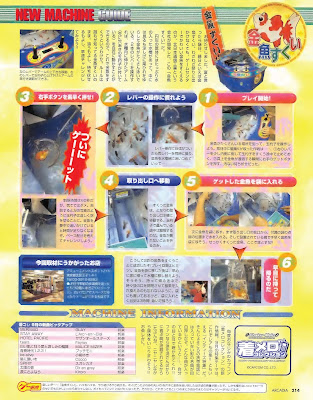
2000 金魚すくい4人プレイ用 (Goldfish Scooping for 4 players) by 北日本通信 (KNT)


Name: 金魚すくい4人プレイ用 (Goldfish Scooping for 4 players)
Year: 2000 
Company: 北日本通信 (KNT)

This is a 4-player crane machine where you scoop live goldfish.  This machine was exhibited in the "New Machine Guide" of Arcadia 0005 magazine, published 2000-10.

Arcadia 0005 (2000-10) via Internet Archive

This game is notable because it seems the USA company Stern Pinball tried to sell it in 2004.

2004 Goldfish Catcher by Stern Pinball

I have not seen any of these in real life, but it is interesting that Stern would have attempted to sell these.  2004 was a severe low-point in the pinball industry, with Stern being the only company left. 
I'll just leave this here.


Here is a video of a Goldfish Catcher in Vietnam:


a mention in Game Machine 2002-03-01


A promotional videotape for this machine has been digitized by the folks at Hard4Games:


The full promo tape was uploaded to the internet archive.


The patent for this machine was filed in 1998 under JP3048891U. (via tweakbod)

JP3048891U


This game was later released in an orange colour scheme, and in this ad we can see the 2-player variant as well as the Mini version.


And for fun,


Saturday, 4 November 2023

1969 Sammy Star Crane - サミースタークレーン by さとみ (Satomi)


Name: Sammy Star Crane - サミースタークレーン
Year: 1969
Company: さとみ (Satomi)


こうして海外への輸出で自信を得た里見は、京都で失敗したクレーンゲーム機に再度挑戦して海外へ売り出そうと考えた。そして「ソナーアタック」発売2年後の昭和45年、現在でもゲームセンターにある、コインを入れハンドルを操作して好きなものを吊り上げるクレーンゲームの原型である「サミークレーン」を完成させた。輸出となると、世界どこでも通用するブランド名が必要になる。そこで「さとみ」から「と」を抜いて「SAMMY(サミー)」というブランド名を付けて売り出した。
Having gained confidence through exporting overseas, Satomi decided to try again with the crane game machine that had failed in Kyoto and sell it overseas. In 1970, two years after the release of ``Sonar Attack,'' he completed ``Sammy Crane,'' the prototype of the crane game still seen in game centers today, where you insert a coin and operate the handle to hoist whatever you want. When it comes to exporting, you need a brand name that can be recognized anywhere in the world. So he removed the "to" from "Satomi" and gave it the brand name "SAMMY" and began selling it.


The text might be unreliable, since Star Crane was listed in the 1969 machine yearbook:

1969 coin machine directory

Since the Satomi article claims the Star Crane was 1970, but it was obviously there in 1969 for the machine directory, I think it is reasonable to say that Sammy Star Crane is a 1969 machine.

It is odd that Star Crane is described as the template for crane games today when Taito and Sega each had very successful cranes earlier.  In fact in the 1969 machine directory, the Sammy Star Crane is just one of about 8 similar crane machines.

Star Crane looks nearly identical to Sega's Skill Diga from a few years earlier.  The only difference I can see, beyond the name and logo on the arm, is that Star Crane has two coin slots to Skill Diga's single, and thus two coin reject buttons.

1965 Skill Diga - スキル・ディガ by セガ (Sega)
1969 Sammy Star Crane - サミースタークレーン by さとみ (Satomi)

the 2 coin slots on Star Crane


Saturday, 17 December 2022

1966 Crane 605 - クラウンクレーンゲーム605 (crown crane game 605) by 太東貿易 (Taito Trading — Crown)

Name: Crane 605 - クラウンクレーンゲーム605 (crown crane game 605)
Year: 1966
Company: 太東貿易 (Taito Trading — Crown)


After years of searching, I found the above image of the 605 crane in テレビゲームの世界 2 [TV Game World 2; Games through the dawn (of video games)], scanned and uploaded by Detchibe.

The 605 had been mentioned in every Taito game list I've seen, but this is the only image I've been able to find after years of searching. 

The 605 control panel has a forward and right button, but I do not know what the circle to the left of them is. It looks like a fancy counter-clockwise arrow circle, with a button in the center.  Perhaps this button mixes up the prizes? This is one of the very few Japanese cranes of this style that I've seen with a backbox marquee.


from the Taito 40th anniversary book

The 603 model was released the same year and was ubiquitous. I do not know how long the Crane 605 was made, but it seems to be exceptionally obscure.

Crown 603 - クラウンクレーンゲーム (crown crane game) by 太東貿易 (Taito Trading — Crown)


a foreigners' guide to eremeka arcades - 外国人のためのエレメカアーケードゲームガイド: introduction & main page - 紹介&メインページ

eremeka search tool  // エレメカ検索ツール begin browsing at the beginning / 最初から閲覧を開始する begin browsing at 1960 / 1960年代から閲覧する begin browsing at 1970...