
Name: Carnival - カーニバル
Year: 1971
Company: セガ (Sega)
Carnival is notable for the vertical bagatelle playfield in the backbox.


flyer scan available at The Internet Archive


from Japan Game Museum:
Carnival is notable for the vertical bagatelle playfield in the backbox.
flyer scan available at The Internet Archive
from Japan Game Museum:

Everyone's favourite Sega game from 1991! Pig Racing!
What? You mean you're not nostalgic for Pig Racing? You've never heard of it? OK well I hadn't heard of it before I started this project either, but I became fascinated by it. Partly because of it's derby mechanic, partly because it was very rare and it took me a long time to find decent images, and partly because it hearkens back to some of the very earliest electrified arcade games of all time!
First off, I bought the flyer. Enjoy!
 |
| Pig Racing - ピッグレーシング by セガ (Sega) |
You can see some footage of Pig Race at 7:12 in this video: (link goes to timestamp, embedded video does not)
Let's go back to some arcade ancestry and look at my old post "arcade photographs from the collection of James R. Smith".
 |
| sign says: "Patented THE CONY RACE May 15 1923" |
These are group carnival arcade games where players compete in a basic task to advance their character. Whoever gets to the end first wins the race! I like these kinds of carnival games because the profit comes from multiple players competing, not from a potentially bunco game.
In The Cony Race players use the lever to hit their ball into a goal.
 |
| Monkey Pinball |
Electrification first came to carnival arcade installations like these, and so what we are looking at are some of the earliest attempts of utilizing electricity in arcade games.
Pig Racing follows in these footsteps.
Pig Racing was included in a 1991 Sega catalogue. Then the first appearance I've seen in a magazine is December 1991.
| from a 1991 Sega catalogue |
 |
| Game Machine 1991-12-15 |
I bought this Coin Concepts Inc flyer and it's dated 1990.
 |
| 1990 Pig Racing by Coin Concepts Inc. |
 |
I still want to believe that Pig Racing is canon for the Sonic The Hedgehog expanded universe..,. |
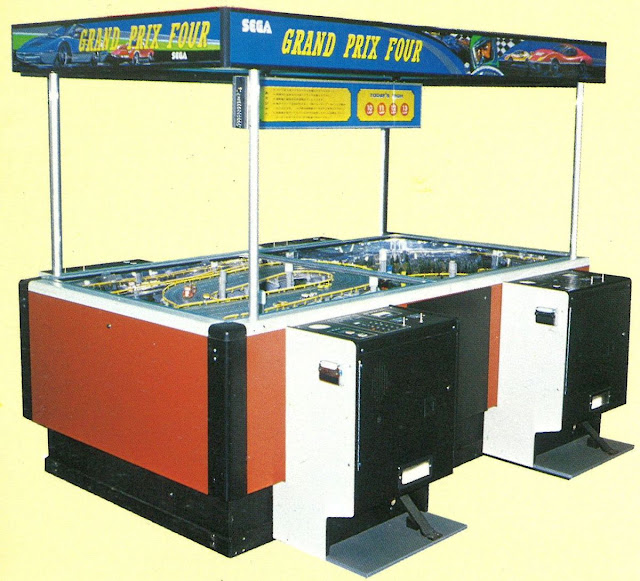
Grand Prix Four is a large medal game that was developed and built by Sega but never made it to full production, despite being exhibited widely in 1978. It could apparently be played as a medal game or as a regular amusement machine.
Four players controlled slot cars racing around the track. There are five lanes, with the 5th being for a rescue vehicle.
 |
| Game Machine 1978-07-15 |
English translation: (edited by tweakbod)
Game Machine No. 100 - Jul.15, 1978 (page 7)
Newly Produced Grand Prix Four
This Year's Sega New Product Exhibition
Sega Enterprises Co., Ltd.’s (Headquarters: 1-2-12 Haneda, Ota-ku, Tokyo, ☎ 742-3171, President Rosen) annual new product exhibition event was an enthusiastic affair with many invited guests at both the Tokyo and Osaka venues.
Movie Tie-in with Star Ship
Although a little later than usual, this year's event was held at the Hotel Pacific in Tokyo on June 27th and at the Royal Hotel in Osaka on June 30th, with President Rosen in attendance. Leading companies from all over Japan attended each of these events, and the new product presentations were lively.
The four-player medal game machine Grand Prix Four, the main game to be announced this time, was placed in the center of the exhibition hall, along with new TV game machines, flippers, Rock-Ola's latest juke 474, and the large screen TV project Sega Vision.
Grand Prix Four is a miniature car racer that pays out medals when it completes a specified number of laps on the course in a specified time. It is about the same size as a Harness Race, and the action of the rescue vehicle to save a car from an off-course accident is a masterpiece. The course is generally elaborate, with a railroad crossing and other features, but it is all done by electromechanical devices.
As for TV game machines, the company has high expectations for the space game Space Ship, the company's newly developed base attack game Secret Base, and the driving games Top Runner and Pro Racer. Among the flippers, the latest in the company's CPU series, Knockout Blow, the new Williams Lucky Seven, Hot Tip, and Stern's Stingray are attracting attention.
.
The only table type exhibited was the company's SuperBowl T II TV game machine. It was also emphasized that the company's four-player gun game machine, Amazonian, had been thoroughly improved.
At the reception that started at 6:00 pm, Vice President Duane Blough gave a speech (translated into Japanese by Mr. Shinohara), expressing his expectations for the company's Space Ship, which will be released simultaneously with the Star Wars movie, and made a presentation to introduce the products on display. Of these, the most noteworthy was the import trend of European and American flippers, and the company announced that it would be supplying the product as an agent of not only Williams, but also Stern of the U.S. and Interflip of Spain.
At the reception, there was a lottery with a special prize of one Sega Vision and ten sets of prize-winning Star Wars admission tickets. The venue was filled with excitement when a Sega Vision was presented to Mr. Sato of Tokai Amusement Co., Ltd. at the Tokyo venue and to Mr. Nakui of Taiko Bussan Co., Ltd.
[photo captions]
President Rosen
Vice President Blough
Top left: The upper and middle photos are at the Tokyo venue
Bottom left: The photo below is from the Osaka venue
The "Star Ship" in the title appears to be a typo, where they crossed Space Ship with Star Wars by accident.
 |
| Game Machine 1978-10-01 |
OCR transcription:
グランプリフォー
セガ社からいよいよ発売に
ミニカーレースをメダルゲーム機化
㈱セガ・エンタープライゼス(本社=東京都大田区羽田一の二の十二、七四二一三二七一、ローゼン社長)から、四人用メダルゲーム機「グランプリフォー」がいよいよ発売される。
これは設定されたサーキットコースをプレイヤーが、アクセル操作して、ミニカーを走らせるというもので、時間内にミニカーをできるだけ多く走らせ、その周数が一定数以上だとメダルが払い出されるもの。
コーナーなどでスピンをして走行不能となったときは救援車を呼ぶことになる。また、コースの途中に踏切があり、汽車が通過するたびに遮断機が降りるが、遮断機に車が衝突すると、それまで走った周数がゼロになってしまう。
標準型ではメダル投入口と百円硬貨投入口の2ウェイになっており、いずれも周数によりメダル(リプレイ用)が払い出される(百円→メダル六枚に換算)。別途コンパ
Machine translation:
Grand Prix Four
Finally on sale from Sega
Minicar race turned into a medal game machine
Sega Enterprises Co., Ltd. (Head office: 1-2-12, 74213271 Haneda, Ota-ku, Tokyo, President: Rosen) is finally releasing the four-player medal game machine "Grand Prix Four".
The player operates the accelerator to drive a minicar around a set circuit course, and if the minicar runs as many laps as possible within the time limit, medals are paid out if the number of laps is more than a certain number.
If the car spins out at a corner and becomes unable to run, a rescue vehicle must be called. There is also a railroad crossing in the middle of the course, and a barrier is lowered every time a train passes, but if the car hits the barrier, the number of laps it has run up to that point becomes zero.
The standard model has two ways, a medal slot and a 100-yen coin slot, and either one pays out medals (for replays) depending on the number of laps (100 yen is converted to six medals). A separate compact is available.
 |
| 1978 AMOA - I think this image is from Replay magazine |
 |
| Amusement Industry 1978--07 |
Via web Tampa '80年代ゲーム同人を自ら振り返る (archive) here are watermarked images of the flyer:


From the article, they identify the cars used in Grand Prix Four. I will excerpt, but include machine translation as well.
寛斎:グランプリ・フォーについては、AFXにハマってた私が少し補足します。アメリカのオーロラという会社のスロットレーシングを1980~82年頃、
トミーが日本での販売権を得たのか、トミー/オーロラAFXとして発売しました。オーロラでは、車の仕様を改良したものを追加発売していきましたが、
日本ではベーシックなものを「マグナカー」オーロラで「G-PLUS」と言っていたものを「スーパーマグナカー」として発売。
その他「スペシャル・マグナカー」という第3のシャーシ、さらに当時の「チューニングマニュアル」1ページ目のカタログに、
「ハイスーパーマグナカー」という第4のシャーシも載ってますが、それはおそらく、F1ブームのときに日本でも発売された、マグネットが追加された新シャーシだろうと推測してます。Kansai: I'll add a little about the Grand Prix Four, as I was obsessed with AFX. Around 1980-82, Tommy acquired the sales rights in Japan for slot racing from an American company called Aurora, and released it as Tommy/Aurora AFX. Aurora released additional models with improved specifications, but in Japan, the basic one was called the "Magna Car," and what Aurora called the "G-PLUS" was sold as the "Super Magna Car." There was also a third chassis called the "Special Magna Car," and in the catalog on the first page of the "Tuning Manual" at the time, there was also a fourth chassis called the "High Super Magna Car," which I believe was probably a new chassis with magnets added that was released in Japan during the F1 boom.
画像 AFX「チューニングマニュアル」1ページ目
AFX "Tuning Manual" page 1
ゴンス:当時あーたとAFXの話なんかしなかったから、今聞いても全然ピンとこない(爆)
寛斎:マグナカーの一覧が出てきたので、グランプリ・フォーに使われてた車種をAFXのカタログから紹介します。Gons: I didn't talk about AFX with you back then, so even if I hear about it now, it doesn't make any sense (lol)
Kansai: Now that I have a list of Magna cars, I'll introduce the models used in the Grand Prix Four from the AFX catalog.
寛斎:左から、「ダッヂチャージャーストッカー」「コルベット」「マーキュリーストッカー」で、これだけは買ったマグナカー封入のカタログから、
「シボレーストッカー」。真ん中の赤い「救援車」は私の知る限りAFXのカタログからは見つけられませんでした。
当時操作したような気もするのですが、車体後方に付け根がある黄色いバーが、ボタンを押すと救援車前方から扇状に後方に向けて開いてたはずです。
ただ、走行不能になった車を、救援車でどうやって救ってたのか、記憶にないんですよね。Kansai: From the left, "Dodge Charger Stocker", "Corvette", "Mercury Stocker", and from the catalog that came with the Magna Car I bought,
"Chevrolet Stocker". As far as I know, I couldn't find the red "rescue car" in the middle in the AFX catalog.
I think I operated it back then, but when I pressed the button, the yellow bar at the base of the rear of the car would open up in a fan shape from the front of the rescue car to the rear.
However, I don't remember how the rescue car saved cars that couldn't run.
Nazox2016 has a great writeup about Grand Prix Four (archive) - read through Translate.
His article also includes a cleaner shot of the train that can block your progress.

 |
| Amusement 1978-09 |

This post is an inquiry into a mystery. It is mostly speculation, but I feel the need to lay out my research and assumptions.
For a long while now, this has made me very curious:
 |
| Western Gun - ウェスタン・ガン |
This is from the 1966 Sega catalogue. We find it in the list of gun games:
 |
| gun games from the 1966 Sega catalogue |
Western Gun is also offered in the "Special Package Sales" section, where they seem to be clearing out machines with bulk discounts. The Sega 1000 Jukebox was from 1960.
 |
| Special Package Sales from the 1966 Sega catalogue |
There are no further public documents that refer to Sega's Western Gun, so currently this appearance in 1966 was the final known reference. (technically, also the first known reference.) I believe that if it was being sold in 1967 that we would have seen references to it elsewhere, as Sega had a large global marketing push in 1967.
I have not seen any arcade machine named "Western Gun", at least not until Taito released their TTL videogame Western Gun in 1975.
In 1956 David Rosen began importing games into Japan, with Seeburg's 1947 Shoot The Bear being a big hit. In some versions of the Mike Munves' catalogues it was referred to as Bear Gun.
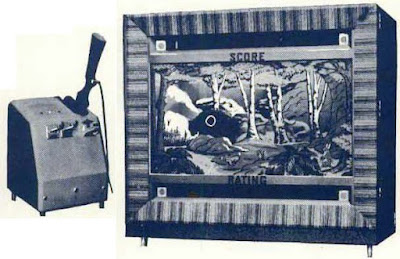 |
| 1947 Shoot The Bear by Seeburg aka Bear Gun |
 |
| Bear Gun in the 1961 Rosen Enterprises catalogue |
I have added "Countertop games" as a category in my eremeka tool. Beyond the early cork and arrow venders, there are not many there so far.
In the 1961 Rosen Enterprises catalogue there are two imported countertop games on offer:

 |
| this is not the most common appearance of an ABT Challenger body |
 |
| Challenger by ABT, with the rocketship-style side art |
In the 1956 Mike Munves catalogue, Bear Gun has a price of $195 and the brand new Challenger by ABT is listed as $55, almost 25% of the Bear Gun price. We can't take these numbers as real evidence, however, since they were from years earlier and the prices of items that have been out for a few years tend to drop precipitously.
For example, in 1956 the Supreme Bulls Eye is listed as $100 for the floor-standing model, and for only $25 more one could get an old upright Exhibit gun game.
But I still think the pricing of Western Gun hints that it must be a similar countertop mechanical gun game.
I think in order to go further, we must give a quick overview of ...
In 1956 JF Frantz purchased the ABT gun games to enter into the world of shooting games.
 |
| Cash Box 1956-03-03 |
 |
| Cash Box 1958-12-20 |
 |
| Cash Box 1959-01-10 |
 |
| Cash Box 1959-04-11 |
 |
| Cash Box 1959-12-05 |
 |
| Cash Box 1959-12-05 |
 |
| Cash Box 1960-01-30 |
 |
| Cash Box 1960-12-10 |
 |
| Cash Box 1961-08-05 |
 |
| Cash Box 1961-12-09 |
 |
| Cash Box 1962-12-29 I have no idea what the SOB (Save Our Business) game is or if it's just a joke, but I'd love to know more. |
This “Save Our Business” thing that every time I asked about it, Johnny would change the subject. Here in the States, S.O.B. is also slang for “Son of a Bitch”. I never could see the tie in with any machine. We found stacks of small printed stencils that say S.O.B. but could never find any direct reference to them. It could have been a promotion for a local (Chicago) operator who was putting his machines in businesses that needed $$$ help, and 50% of the coins played could make a difference. We too are curious about this SOB thing.
My “Trick Shot” is slightly different than the one in the photo. It has no front handle or knob. It uses the U.S. Marshal gun. The side graphics are simple. A cowboy holding a hand mirror and shooting at a target over his shoulder. The targets are modified “Kicker Catcher” score wheels to count how many times you hit each of 3 targets.
 |
| Coin Journal 1979 - sold by 日本商事 (Nippon Shoji) |
 |
| Game Machine 1979-05-01 |
This is how they were advertised in North America in the 1980s:
 |
| US Marshall (left) was sold for at least 2 decades. |
 |
| this excerpt from a parts flyer illustrates how they sold a number of models which used the same parts |
I have been curious about this Japanese machine with the title Colt:

We know this game existed in Japan in at least 1966, since we can see it in an episode of Ultraman:
 |
| 1966 ウルトラマン 第10話 謎の恐竜基地 (Ultraman Episode 10 Mysterious Dinosaur Base) |
This appears to be a JF Frantz gun game with a custom cabinet, stand, and marquee. I do not think this was an American game since I doubt any USA company could get away with naming a machine after a famous gun brand that was over 100 years old at that time.
Look at the gun and coin mech on Colt:

 |
| U.S. Marshall gun and coin mech assembly |
 |
| ABT gun mechanism / coin slot |
 |
| source: Target Skill by ABT |
Is this the Western Gun we are searching for? Possibly, but I believe if the cabinet has COLT brazenly displayed across it, the Sega catalogue would have included it under the name Colt. They were very good at selling products with their accurate English names. Why would they change it this time?
The movie 乾いた花 was released in 1964 and in the bowling alley scene we can glance at the concessions counter and notice something of interest. (check out the full arcade exploration of Pale Flower over here)


 |
| 1959 Dodge City by JF Frantz |
Is there a chance someone deliberately removed the marquee of a game released just a few years early? Perhaps. But another possibility is that what we see in Pale Flower is indeed Sega's Western Gun, and Sega made a faithful copy of Frantz's Dodge City game. As was sometimes the case, especially for some companies in Japan in the 1960s, the mechanisms themselves could have been imported and a slightly different game was sold in Japan.
In the Sega in the 1960s article, we see how many of the early Sega electromechanical machines were based on designs from around the world. But Sega didn't import, they always built their own versions.
Other manufacturers, like with Satomi's Pony Derby or Skee Ball, seemed to have purchased parts from foreign companies and reworked their designs slightly for the Japanese market. It would not be shocking to discover a similar arrangement at work here, especially with ABT focusing on selling the gun parts. (I am assuming they are still operating and manufacturing parts, as per the article about the sale to Frantz)
This is a very ambiguous case and I will need to discover more evidence before I can rule out or confirm this possibility.
This is a countertop gun game with a Western theme, out of VERY FEW OPTIONS for what Western Gun could possibly be. While it is encouraging to note that the game in Pale Flower does not have the Dodge City marquee, this is still circumstantial evidence.
A few things to note for future research:
The building in the Dodge City machines has the title "GOLD GULCH SALOON".
 |
| "GOLD GULCH SALOON" on Dodge City |
In all of the later machines I've seen, like U.S. Marshall, it has been renamed to "SILVER DOLLAR"
 |
| "SILVER DOLLAR" in all but the earliest Frantz gun games |
Here is a vintage copy of Dodge City. Or maybe it's Western Gun? At least on this machine, I can see that the paint difference at the top side edge suggests it might have had a marquee at some point.

Gameplay of Dodge City:
Since this game is anchored by the 1964 movie, we are currently assigning the companies to Nihon Goraku Bussan and Nihon Kikai Seizo.
Added 2025-03-15: pictures of Dodge City from an auction


eremeka search tool // エレメカ検索ツール begin browsing at the beginning / 最初から閲覧を開始する begin browsing at 1960 / 1960年代から閲覧する begin browsing at 1970...


