Showing posts with label gambling. Show all posts

Tuesday, 28 July 2026

1974 Stop & Stop - ストップ・アンド・ストップ by 昭和遊園機械 (Showa Yuen Kikai)


Name: Stop & Stop - ストップ・アンド・ストップ
Year: 1974
Company: 昭和遊園機械 (Showa Yuen Kikai)


Stop & Stop is a game where after a coin is insert, the dial rapidly spins and the player can press a button to stop it on a number. If the player has not pressed a button within a rather short timespan, the arrow will randomly stop on its own, like a slot machine. The player gets three spins and their total determines the outcome. It is set to 10 yen play.

Stop & Stop appears in the 1974/1975 machine directory and the 1978 machine directory.

1974/1975 machine directory entry

1978 machine directory entry

Similar to the machine Playlearn ABC, this machine appears to be a modified version of a German addimint machine.


1974 Playlearn ABC [seen in ラブラブ・ライバル] by unknown


the Stop & Stop dial values match the addi-mint


1963 addi-mint standard by NSM


The payout proportioning was probably kept the same on Stop & Stop. To alter it would require some sensitive engineering! Just convert 10 pfennig pieces to 10 yen coins, much easier. 

Payouts for each final value would be:

12: ¥100
11: ¥80
10: ¥50
9: lose
8: ¥20
7: lose
6: ¥10 yen (your coin back)
5: lose
4: lose
3: ¥10
2: ¥10
1: ¥100
0: ¥100

This payout structure offers some gameplay decisions. The 0 or 4 are the numbers you are aiming for. Each is bounded by 2s, so a pro at this game will get punished severely as the 2 is the mediocre result. Going for 3x4=12 offers a smoother consolation if you miss the 4, but realistically you'll end up on a 2 meaning the best you can do is 4+4+2=10. But 50 yen for 10 yen play is still enticing.

Going for 0 might seem more enticing as there are 2 values that pay 100 yen, but if you are aiming for the 0 and miss you probably just hit a 2, making a 10 yen return your best case scenario.

My intuition says try for 12.


Some footage of the addi-mint in action. They do not use the stop button. 


There was an underground industry active in the 1970s where German machines were imported and converted to yen. It has been a bit of a treasure hunt to identify converted machines from that era.

Another example of this, from the same company, is 1974 Stop Joker by 昭和遊園機械 (Showa Yuen Kikai)

Monday, 14 July 2025

1974 Playlearn ABC [seen in ラブラブ・ライバル] by unknown

 
Name: Playlearn ABC
Year: 1974 or earlier
Company: unknown


This game can be seen in 2 screenshots of the Japanese TV show ラブラブ・ライバル (Love Love Rivals), as shared by TOO_yoshikawa (archive)

ラブラブ・ライバル 第21話 「雪のロマンス?」(1974年2月19日放送)

ラブラブ・ライバル 第21話 「雪のロマンス?」(1974年2月19日放送)

This episode aired in 1974 but the game could have existed earlier.  This is the only example of this game I have ever seen.

This game appears to be a reworking of a German Addi-Mint machine by NSM. There is a single button at the center, bottom, and a ring of numbers around it.  You spin the wheel 3 times and the sum of your spins determines if you win.

The dimensions of Playlearn seem slightly different than the addi-mint machines, but sometimes a camera distorts things, and sometimes cabinets could be changed.

1963 add-mint standard by NSM

1964 addi-mint Juwel by NSM

Many German Rotamint-style machines were brought into Japan and used for gambling purposes, and I suspect that Playlearn ABC is another example of that.


Tuesday, 25 February 2025

1966 Strike A Lucky Token by 太東貿易 (Taito Trading) & パシフィック工業 (Pacific Industries) [presumed]


Name: Strike A Lucky Token 
Year: 1966
Company:   太東貿易 (Taito Trading) & パシフィック工業 (Pacific Industries) [presumed]

Lucky Token, as it is commonly referred, is a slot machine that was unveiled at the 22nd A.T. E. Exhibition in the UK in 1966.  It was brought by Taito Trading, and the full title on the marquee is "Strike A Lucky Token".  Like most Sega slot machines of the time, it appears to be made specifically for export.

Cash Box 1966-02-12

F. Dennis Dent, Managing Director of Shipgoods Ltd., the agents for Taito Trading Company of Japan, is seen here (left) explaining the mechanism of the Lucky Token Fruit machine to Neville Marten (CASH BOX).


Cash Box 1966-02-12

Also exhibiting for the first time Taito Trading Company of Tokyo, Japan on the stand of their U.K. importers and distributors, Shipgoods Ltd. Managing Director Mr. F. Dennis Denton reported that the Lucky Token two plays for 6d 'pub' slot machine created tremendous interest, as did the Casey Jones kiddie train ride.


Coin Slot 1966-01-29

REGENT Automatic Supply demonstrated the Japanese fruit Strike a Lucky Token, which is on two pulls for 6d, and which pays out two coins in cash or a 5/- award. When the jackpot is won a buzzer sounds and a red light flashes next to the coin entry.
An innovation on this machine is a special panel which can he unlocked by the site owner and through it he can load the award tube which might be in danger of emptying.
A special light goes on when this may happen and goes out again when the tube in refilled. Thus the key can be safely left on site without any threat of unlawful access being gained to any other part of the machine.


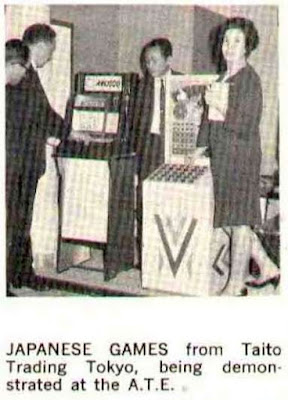
This was Taito's first A.T.E. Exhibition.  They also exhibited Amosco [アモスコ by アオシマ・モウカル・オカネ・シコタマ・カンパニー (Aoshima Moukaru Okane Shikotama Company)] and ホイホイテスト (Hoi Hoi Test) by 日本遊園設備 (Japan amusement park equipment).

Billboard 1966-02-12


Coin Slot 1966-01-22
ad from Regent Automatic Supply

Coin Slot 1966-02-05

Relevant text from the bottom, highlighting the feature of a special locked slot that allows the location owner to restock the payouts without gaining access to the cashbox or internals.

Bottom centre: Messrs. T. and A. Manzi, of Regent Automatic Supply, introduced the Japanese-made Lucky Token fruit machine. A feature of this fruit is that by unlocking a small plate on the front the site owner can restock the token tube without gaining admittance to the rest of the machine.

Coin Slot 1966-02-05
Zooming in on the Lucky Token photo

Lucky Token appears to be based on Royal Crown slot machines.

photo by Anthony Gavin - flickr

Royal Crown machine with the mounted marquee


Photos of a Lucky Token machine, taken from an Ebay auction (archive):

where the price is listed as 6D there is a key hole.  I assume this is where the "lucky tokens" can be refilled by the location operator.

note the dual payout tray, one for the 2-coin payouts, and one for the lucky tokens

It says "Imperial Crown" here.  Crown was a brand utilized by Taito as early as 1965.  Unsure if that's a solid connection though since the original model design was Royal Crown.


is that "T" for Taito?  On the Royal Crown machine this is instead a plastic circle with 'JP' on it.  It probably just means "T" for "Token", as it lights when it pays them out. 


inspection card!  Inspected by T. Kaburagi on 1966-06-13

For comparison, a friend sent me a similar inspection card from the same era, this one from a Sega Mad Money machine:

1969-02-04 inspection date, this one is 110 Volts and 50 Watts, so for the Japanese market


The chevron on the Royal Crown and Lucky Token machines remind me of the one that would appear on サニー東京 (Sunny Tokyo) / Sunic machines

chevron from Royal Crown

chevron from Mercado Electrica - メリカー ドエレクトリカ by サニー東京 (Sunny Tokyo)

chevron from Wander 69 - ワンダー69 by サニー東京 (Sunny Tokyo)

Perhaps it was just stylish?  But perhaps they saw Lucky Token and/or Royal Crown and were inspired. :)


One more advertisement, also from Regent Automatic Supply:

Coin Slot 1966-03-26


There does not seem to be any mention of their geographic origin in the ad copy, though the first ad did say "Introducing to England".


Also in 1966 Regent Automatic Supply began advertising Super Lucky Token, where they convert between "single jackpot payout" and "progressive jackpot", though I am unclear which is which.  The sign still seems to say "Strike A Lucky Token" but Super Lucky Token is used in the ad copy.

Super Lucky Token by 太東貿易 (Taito Trading) & Regent Automatic Supply

Coin Slot 1966-08-27

 
Coin Slot Review 1967 Spring


Wednesday, 23 October 2024

1965 Amosco - アモスコ by アオシマ・モウカル・オカネ・シコタマ・カンパニー (Aoshima Moukaru Okane Shikotama Company)


Name: Amosco - アモスコ
Year: 1965
Company: アオシマ・モウカル・オカネ・シコタマ・カンパニー (Aoshima Moukaru Okane Shikotama Company)

Amosco is a 5-reel slot machine released in 1965.  It comes in two different reel varieties.  SP-1型 has dice reels, SP-2型 has fruit reels.  It has 5 "skill stop" buttons.

60 Years Of Pachinko Industry

Transcription:

●新型ゲームマシン「アモスコ」。「アオシマ・モウカル・オカネ・シコタマ・カンパニー」の略。要するに青島幸男の考案である。サイコロの目を使ったものとフルーツ図柄を使ったものと2通りあり、写真は後者の「SP-2」型。SPとは「しょっぱな」の略である。10円硬貨を2枚入れてレバーを引くとドラムが回転、ストップボタンで目を揃えるという、ただのゲーム機だが、半年間で400台ほど売れたという。

Machine translation:

●A new type of gaming machine, "Amosco." It stands for "Aoshima Moukaru Okane Shikotama Company." In other words, it was invented by Aoshima Yukio. There are two types, one that uses dice numbers and one that uses fruit designs, and the photo shows the latter, the "SP-2" model. SP is an abbreviation of "Shoh-han-na." It's just a gaming machine in which you insert two 10-yen coins, pull the lever to spin the drum, and press the stop button to align the numbers, but it seems that about 400 units were sold in six months.


Coin Slot 1966-01-29
 

TAITO Trading Co. Ltd. are newcomers to the ATE and showed a number of pieces of equipment which are of Japanese origin. Among them was the poker game, Amosco.
Shaped like a fruit machine there are five panels through which numbered dice may be seen. When 6d is inserted and the handle pulled the five dice are scrambled and when they come to rest the player has to develop a poker hand preferably five of a kind with the red dotted aces wild.
The dice are "shaken" each time by pressing a button and can be stopped by pushing another button above it. The catch is that there is a time limit of one minute and the time passing is denoted by an illuminated second hand on the fascia glass. This game can also be played by using fruit symbols.
A kiddy ride ride called Canonball Express which makes all appropriate train noises was also to be seen, as was the Strike a Lucky Token fruit which is described elsewhere.

Summarizing the rules above:

  • one minute game time
  • player must make the best poker hand with 5 dice / fruit
  • First button in front of each reel spins that reel
  • Second button stops the reel 
  • red-dotted aces are wild


Taito Trading brought Amosco to the ATE tradeshow in Britain in February 1966.

Billboard 1966-02-12
The machine on the right is ホイホイテスト (Hoi Hoi Test) by 日本遊園設備 (Japan amusement park equipment)


Kansai Seiki catalogue, ~1967

The dimensions given above: width 45cm, depth 45.5cm, height 58.5cm, 32.5 kg weight, 65 cm stand height.  With an option for 10 yen or 20 yen play.


arcade from an onsen brochure


I did not prepare a full Arcade Exploration, since there is only this one machine, but let's look at a movie from 1972.

1972 - 銀蝶流れ者 牝猫博奕 / Gincho nagaremono mesuneko bakuchi (Wandering Ginza Butterfly 2: She-Cat Gambler )

in the background we see a brown AND red Amosco machine.  When the view changes, we only see a brown machine in a different location


Later in the movie, we finally get a close-up

dice reels, so this is SP-1

SCORE SHEET


the illuminated clock counts down the 1 minute of playtime


An Amosco machine can also be spotted in ウルフガイ 燃えろ狼男 (1975) aka Urufu gai: Moero okami-otoko aka Wolf Guy.

ウルフガイ 燃えろ狼男 (1975) aka Urufu gai: Moero okami-otoko aka Wolf Guy


a foreigners' guide to eremeka arcades - 外国人のためのエレメカアーケードゲームガイド: introduction & main page - 紹介&メインページ

eremeka search tool  // エレメカ検索ツール begin browsing at the beginning / 最初から閲覧を開始する begin browsing at 1960 / 1960年代から閲覧する begin browsing at 1970...