Name: テレコンカラー太陽 Challenge Ball (Telecon color sun Challenge Ball)
Year: 1979
Company: 太陽電子 (Taiyo Denshi — Electron)
Telecon was the earliest arrangeball I've seen that has a a TV screen inside of it. Also from 1979, TV Sparrow Ball is another title that has a screen embedded. Where that game keeps track of your mahjong game on the screen, the article on Telecon below says it has Space Invaders and Breakout-style minigames. How are they controlled? You press the button near the pachinko handle to fire a missile in the UFO game. Press a button to stop the roulette wheel in the worm roulette game. Were they hoping to also include a Breakout-style game?
Tweakbod found this article in the Japanese-language San Fransisco newspaper Hokubei Mainichi, and provided the transcription and machine translation.
full page 2 of Hokubei Mainichi 1979-07-21
article excerpted from Hokubei Mainichi 1979-07-21
Machine translation:
Invader Pachinko Arrives: The Allure of Winning Prizes
(Nagoya) Striking Back at the Invaders—! The pachinko industry, left gasping for air as the Invader craze siphoned away its customers, has found a new source of buzz with the debut of the “Telecon Machine”—a device that could be described as Invader Pachinko.
Developed by a pachinko machine manufacturer in Nagoya, the machine’s key innovation lies in embedding a small television screen directly into the center of the pachinko cabinet, allowing players to enjoy both pachinko and an Invader-style game simultaneously. Following its debut in Kanda, Tokyo, this past July, the machine is now set to appear in locations across the country. Unlike Invader games—which typically involve spending money without any tangible return—this machine offers the chance to win prizes. Consequently, pachinko parlor operators are already enthusiastic about using the “Telecon Machine” as their trump card for a pachinko industry resurgence. “This is the leading contender for the 'Post-Invader' era,” remarked (Owner of M Pachinko Parlor in Kanda, Tokyo) “With this, we can bring our customers back.”
Pachinko, once the undisputed king of mass entertainment, has recently seen its crown usurped by the Invader boom. As operators face a wave of business closures and industry exits—with some lamenting, “At this rate, it’s a matter of survival” (as noted by D Pachinko in Nagoya City)—the industry has been racking its brains to devise countermeasures against the Invaders. It is against this backdrop—carrying the industry's hopes for revitalization—that the Telecon Machine has made its debut.
Playing the Telecon Machine is simple: insert a metal token (priced at 50–70 yen each) to start the game. Following the same mechanics as traditional pachinko, players launch 16 steel balls into a designated catch-tray (replacing the traditional tulip pockets); successfully doing so allows them to manipulate the numbers displayed on the TV screen mounted in the center of the cabinet. If the numbers align vertically, the TV screen instantly transforms into a UFO-shooting game; if they align horizontally, it switches to a block-breaker style game. As players fire missiles to target the erratically moving UFOs, the machine emits electronic sound effects—such as “pyun-pyun” and “gwaaan”—creating an atmosphere that perfectly captures the spirit of the original Invader game. In short, the Telecon Machine offers the pure fun of the Invader experience, combined with the unique pachinko thrill of winning prizes.
The price of a single Telecon Machine unit is approximately 300,000 yen—about three times the cost of a standard electric pachinko machine—yet in terms of capital investment, it remains cheaper than the 500,000 yen required for an Invader. Consequently, the industry is making bullish projections: “With the Invader craze finally showing signs of winding down, this is bound to be the next big hit as a wholesome form of adult entertainment” (T Electronics, the developer of the Telecon Machine); and, “Just like with pachinko, entry is restricted to those aged 18 and over, so there is no need to worry about issues regarding juvenile delinquency” (Nagoya City Amusement Association). But the question remains: will they truly be able to shoot down Invader exactly as they’ve calculated?
[Photo Caption] A pachinko machine featuring a small built-in television screen in the center, allowing players to enjoy Invader games as well.
Jumbo is a wonderfully oversized pachinko cabinet surrounded by a western shootout theme. I like it for the nixie tube scoring in the center.
While this flyer is small because I only could get this thumbnail image, it does show us that it was distributed under the brand name Nihon Jihan, and has the type approval number 91-8108.
If we look up type approval number 91-8108 we see it was registered by 昭和遊園機械 (Showa Yuen Kikai) in 1972.
We do not know if it was actually released in 1972 though. In fact, Jumbo does not appear in any of the annual machine catalogs. but we do know it exists in 1973 because it appears in the movie 愛欲の罠 / Aiyoku no wana aka Trapped in Lust (1973).
This early machine uses a large ball, not a small pachinko ball. There are a handful of European machines that use this size of ball. Note the size of the hole comes out of.
There is a similar machine in a famous catalogue that is estimated from around 1929.
1錢の玉遊び [No. 16] (A ball game played with 1 sen) by 日本娯楽機製作所 (Japan Amusement Machine Manufacturing)
There are a few notable differences between this machine the photographed machine above, but they are both strikingly similar. This one also has the meshed hoop ball entrances, the hole layout is adjusted slightly, and this one appears to have a coin-return slot.
I have encountered a few other machines with a similarly large ball, but even these are extremely obscure (presumed) British games.
Each of these pockets has 3 horizontal bands and one center vertical band. I believe the British machines are late 1920s, though it's hard to say for sure since documentation is scarce. While I am leaving this machine as ~1920s, it might be early 1930s. That Top Hat machine is listed as 1933...
This Bolland machine was listed as "1930s", but I have yet to get that confirmed. as you can see by the ball hole, this is another large ball game.
The 3 Sixes by Bolland
Another Bolland machine that appears to use a similar ball, but very different gameplay:
1930s Beat The Goalie by Bollands
One thing I look for is the ratio of Ball Hall size to coin slot size. we can see similar examples of large ball games if we look back a decade or two earlier.
1910 The Cresset by Cresset Auto Machine Co.
look at the ball hole size:
Pickwick:
A look at the balls:
we can also see larger balls used in earlier French machines:
French slot machine, stamped inside A Bessmann
As best I can tell, the use of larger balls began with Pickwick style machines, but then fell out of fashion in the early 1930s.
A few German wall machines post-World War II used similarly sized white balls, with a number of popular machines in the late 60s and into the 70s. Many of these German machines were imported into Japan in the 1970s, and a number of Japanese arcade machines in the 1970s copied aspects of the German designs.
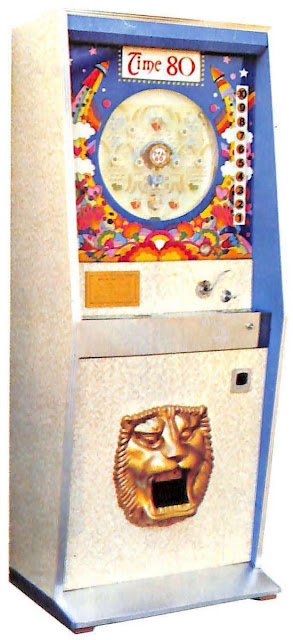
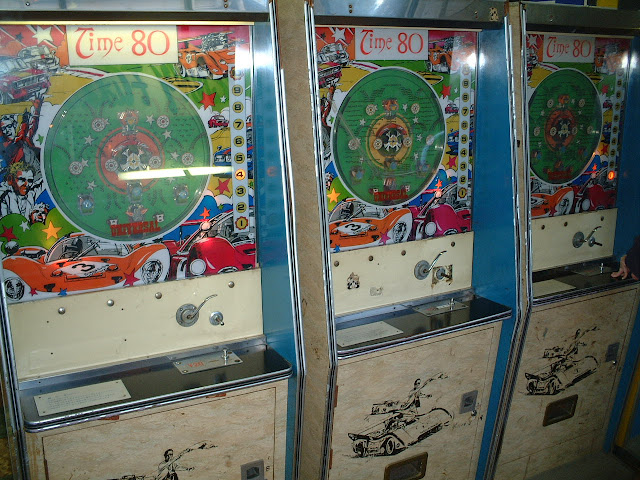
Time 80 is a popular arcade game where the player has to hit a number of pachinko jackpots in a limited amount of time. I have identified four artwork and cabinet variations of this game.
The first two have the iconic lion head prize dispenser, but different bezel art. The latter two have a stencil of a race car on the cabinet. One of the race car variants has a speaker grille.
This machine appears to have been copied by Play-Mate - プレイメイト by 新潟ジューク (Niigata Juke), but in all fairness there were already a number of similar games on the market since the 1960s.
The earliest appearance so far, with the original and more obscure artwork, was in March 1972.
Amusement 1972 – 03
We have scanned and shared two Universal corporate guides. In these documents, it lists Time 80 as 1970. That feels like a major discrepancy, and I wonder if that is one the project began and not when the game was released? Normally with a corporate document like that would I would defer to it, but in this case I am going to leave the year as 1972 until I can find further information.
If anyone has any corroborating evidence about Time 80 in 1970 or 1971, I would love to see it!
Excerpt from Universal corporate profile, approximately ~1981
If it was created in 1970, it was advertised as a new machine from Nihon Jidô Hanbaiki in 1972.
"Japan Vending Machine", which is always popular for its unique products, has released another hit product, "Time 80". It is a thrilling and interesting game machine that challenges the time suitable for the speedy era. After inserting 20 yen, you can play as fast as you want for 80 seconds. If you successfully get 10 balls in during that time, you will get a free caramel. It seems that another attraction for children has been added to the game, and it will surely be popular. <Specifications> Height 1670/m Width 670mm Depth 465/m Power AC100V40W Weight 55kg <Contact> Japan Vending Machine Co., Ltd. Headquarters 2-1 Nihonbashi-dori, Chuo-ku, Tokyo (Room 709, Daido Life Building) Tel: 03 (271) 4547~8 Osaka (office) 3-37 Satahira-cho, Moriguchi-shi, Osaka Tel: 06 (903) 0240
Time 80 does not appear in the 1972 machine directory, but does appear in the 1973 machine directory (which was printed at the end of 1972).
1973 machine directory
This is the most well-known version, with the sports car art and the lion-head dispenser.
In later versions, the lion head is gone, replaced by a rectangular slot. The cabinet now has a stencil of a race car.
I have no date reference for this specific cabinet, so I am assuming it is around 1973
In an advertisement from 1973, we can see an illustration of Time 80 with this stencil, blue cabinet, no speaker panel.
Amusement 1973 – 05
The off-white cabinet seems more obscure than this typical blue cabinet.
I am not considering the blue and off-white cabinets as separate games. But there is one more variation.
This version of Time 80 has a speaker grille
instead of the circular holes the grille here is horizontal lines. For the sake of the database, I am considering these to be the same machine.
this manufacturer plate is from the machine above, with the horizontal speaker grille. TAN 91-5539 日本自動販売機
Except for the very first version that we talked about, every Time 80 has the universal logo displayed front and center. This game would be followed up quickly by New Time 80.