Bally Japan Co., Ltd. People's
eyes widened in surprise at the catalogs written in English; this was
the first reaction of those who received the catalogs. They handle
products from the familiar Bally company. The exhibit included the
bingo game machines Super Wall Street and Bull Market, the flipper game
machines Aladdin Castle and Freedom, and the slot machine Gold Rush. As
these are all familiar and popular products, this corner attracted a
particularly large number of people.
IPDB says this was a conversion to 1974 Bali, and we can see Bali does have the same cabinet art.
Bull Market is a Bally game that might only have been sold in Japan. The only documentation we have seen is from Japan. IPDB has the release date of 1976-03-15.
Bally Japan Co., Ltd. People's eyes widened in surprise at the catalogs written in English; this was the first reaction of those who received the catalogs. They handle products from the familiar Bally company. The exhibit included the bingo game machines Super Wall Street and Bull Market, the flipper game machines Aladdin Castle and Freedom, and the slot machine Gold Rush. As these are all familiar and popular products, this corner attracted a particularly large number of people.
Bull Market Bally Japan Corporation has recently released the "Bull Market" bingo game machine, manufactured by Bally, Inc. of the United States. To play, insert six coins, and six cards will appear on the board. Players choose their own arrangement and use five balls to aim for numbers from 1 to 25. Numbers can be lined up vertically, horizontally, or diagonally, and the goal is to get three or more in a row. If an extra coin is inserted, there is a chance to move the center spot of each card before the third or fourth ball. Furthermore, lighting up a corner gives the player a chance to score the same as a 5-in-line, among other features that enhance the enjoyment of the game.
<Specifications> Size: Width 710mm / Height 1,860mm / Depth 1,450mm Weight: 161 kg Electrical: 110V/250W/50-60Hz <Contact Information> Barry Japan Corporation Head Office: Akabanebashi Building, 1-26-1 Higashi-Azabu, Minato-ku, Tokyo 03(583)0881 (Main) 106
Bull Market appears to be a conversion for the 1975 game Blue Chip. The side art matches, and the backglass appears to just have a name change.
The only image I've seen of Asteroid Killer so far is from this write-up in Play Meter 1979-12-15. The image shown above is the highest-resolution composite image, taken from the scan. (normally I limit images to 1200p)
Play Meter 1979-12-15
Play Meter 1979-12-15
The IPDB has this game as 1980, and it probably was released in 1980. But for this database we follow the methodology of tracking when a game first appears. So if it's shown in 1979, we're marking that down as 1979.
Another note is that I do not use any Japanese characters for the game. I do not use a Japanese title until I see it used by a primary source. I wonder if this machine was ever mentioned in Game Machine, and I missed it? I currently do not have any Japanese magazines from 1979-12 or early 1980s.
Name: Let's Go! Bazooka [Let's Go Bazooka] - レッゴー・バズーカ
Year: 1969, ~1970?
Company: ホープ自動車 (Hope Motor Co — Hope Star)
There are two variants of this game. The one with the red back glass appears in the 1969 machine directory. In the ad copy there it is described as a new game, which is why I am placing it as a 1969 machine.
1969 machine directory
The ad does not mention the steering wheel, but I imagine it is used to tilt the playfield. when the ball goes under the tank standups, the players supposed to press a button to detonate it and score.
There is an alternate back glass, I referred to as the blue one, and I assume this is the later version of the game. The marquee no longer has the exclamation point. there is now art on the apron, but the cabinet has lost its cool strips. Also the large red button on the left and the lockdown bar is gone.
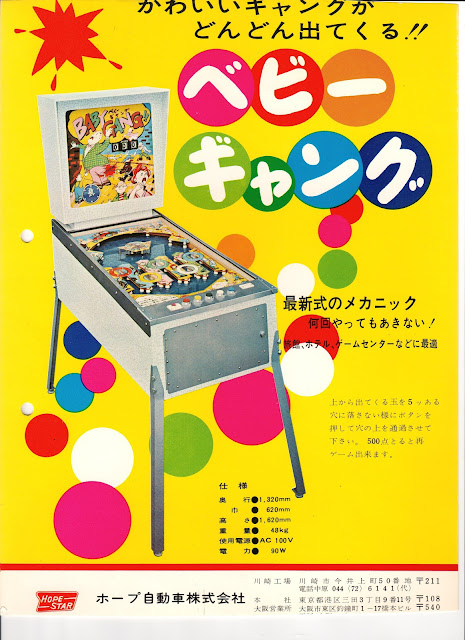
Further supporting evidence that this game came later is that it shares a similar cabinet as used in Baby Gang and Torpedo Shark, which we know were released in 1970. I do not have any more information, so for the time being I am labeling this one is being from approximately 1970.
The Bazooka coin door matches the coin door of Baby Gang, but Torpedo Shark has a slightly smaller coin door in this picture. But, in a November 1970 magazine Torpedo Shark has the smaller door, but in January 1971, there is an advertisement with the larger tour.
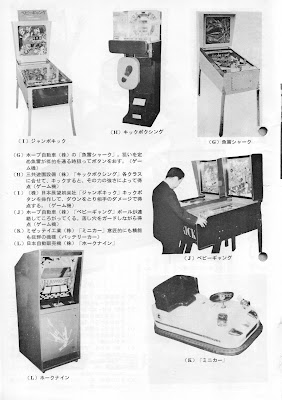
Baby Gang - ベビーギャング by ホープ自動車 (Hope Motor Co — Hope Star)
Torpedo Shark - 魚雷シャーク [シャーク] by ホープ自動車 (Hope Motor Co — Hope Star)
Robot Gun has the same coin door size as Torpedo Shark, along with the same handlebar controller. Let's Go Bazooka uses this style of handlebar in the second iteration.
Robot Gun - ロボットガン by ホープ自動車 (Hope Motor Co)
But it is important to stress this is not a guarantee that the blue version definitively came out in 1970, or even was the second version.
From the Taito 40th and bursary book, Crazy Ball is listed as from 1968.
Taito 40th book
This is another catching game, where the player uses the wheel to catch the balls that fall down the playfield towards them. Small metal balls are ejected into the playfield, and shot around by the large center spinner.
It appeared in the 1969 machine directory, but could be from an earlier year. I wish I had more information about Sankyo's early years. They released many wonderful machines in the 1960s, but there are very few references as to when they were made, or even the order in which the machines were released.
gameplay starts at 3:11 in this video:
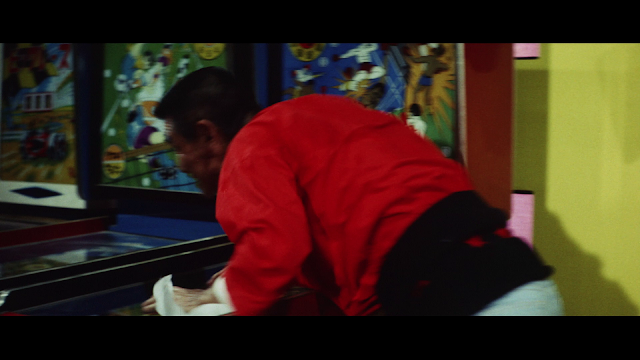
This game can be spotted in the 5th Truck Guys movie... 度胸一番星
Name: Underground - アングラ Year: 1969 or earlier Company: 日本展望娯楽社 (Nihon Tenbo Entertainment Company — Nitten)
Thank you to @area51_zek for sharing this wonderful rare flyer! (archive)
This game operates on a timer and if you can score 80 points you win a free game. There are 5 slots along the bottom for a ball to settle in to. Each of the 5 buttons fires the kicker at the targets. I am unsure if there is any timing strategy, or if the goal would be to fire the ball immediately each time.
The ad copy says you insert 10 yen, but the game has a 20 yen slot in the photograph.
This game appears in the 1969 machine directory, though I do not know if it came out that year or earlier.
I would like to argue that these machines from 日本娯楽機 (Nihon Gorakuki) were probably built in collaboration with 日本展望娯楽社 (Nihon Tenbo Entertainment Company) as well. Given the machine timeline we have currently assembled, I think it was one of the last machines built by 日本展望娯楽社 (Nihon Tenbo), or at least utilized their remaining parts.
There are two versions of this game, though they have many overlapping parts and artwork. I will explain the differences below.
These machines could not exist prior to 1971 as it references characters and images from 帰ってきたウルトラマン / Return of Ultraman, like Ultraman Jack, and the MAT logo (Monster Attack Team). I have not found any advertisements for these machines, but if they came out in 1971, we have very little material from that year to research from.
There are many things to discuss, so let's get started.
Establishing some background on 日本娯楽機 (Nihon Gorakuki)
日本娯楽機製作所 (Japan Amusement Machine Manufacturing) was one of the first amusement machine manufacturing companies in Japan, publishing a famous catalogue around 1937. (see the Research Notes page for more details on that.) At first I did not think they were connected, but if we look at the company information for 日本娯楽機 (Nihon Gorakuki) from 1974, the representative is none other than amusement machine legend 遠藤嘉一 (Kaichi Endo)!
We do not see 日本娯楽機 (Nihon Gorakuki) in the back of the machine directories until 1974/75, where they are listed as making amusement vehicles.
Nippon Entertainment Machine Co., Ltd. Representative Yoshikazu Endo Address: 2-22-4 Aoyama, Minato-ku, Tokyo 107 TEL 03(402) 7311~3 Capital 38 million yen Main banks Daiichi Kangyo (Aoyama), Kyowa (Akasaka), Taiyo Kobe (Akasaka) Main clients: Korakuen, Matsuya, Tokyu Department Store, SS Pharmaceutical, etc. Business Line: Manufacture and sale of electric entertainment vehicle machines.
An advertisement for the 1972 game Ultraman Ace has even more proof that they are the same company. Beneath the Nihon Gorakuki logo "NGK" it says 創業50年 (50 years in business).
We had not seen much of Nihon Gorakuki in the interim years. I hope to learn more about what happened to them, and Kaichi Endo, through the 50s through 70s. One major achievement of NGK appears to be their licensing.
While Ultraman Ace is listed as by Sankyo, I presume the NGK partnership is about licensing the Ultraman characters.
We see a number of rides and vending machines made by NGK in the 74/75 machine directory.
1974/75 machine directory: machines listed as by 日本娯楽機 (Nihon Gorakuki)
1974/75 machine directory: machines listed as by 日本娯楽機 (Nihon Gorakuki)
1974/75 machine directory: machines listed as by 日本娯楽機 (Nihon Gorakuki)
Side note: those vending machines are pretty legendary. That links to 北原コレクションチャンネル and they also own another:
The company information in the 1976 machine directory is the same:
1976 machine directory
In the late 1970s we see some larger advertisements from 日本娯楽機 (Nihon Gorakuki)
日本娯楽機 (Nihon Gorakuki) advertisement from the 1978 machine directory
And in the 1978 directory their company information has not changed much either, except with a fresh location added:
1978 machine directory
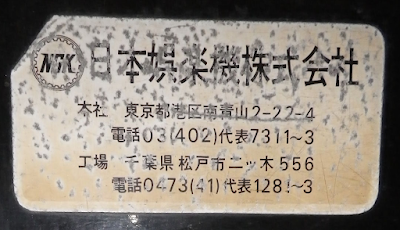
The 1978 machine directory has an additional address and phone number, this one in Matsudo City phone # 0473 (41) 1281 and that matches the NGK sticker on the front of Ultra Attack. I have not seen this phone # or city referenced in other NGK flyers, but it does also appear in the 1979 and 1980 machine directories.
sticker on the front of Ultra Attack with 日本娯楽機 (Nihon Gorakuki) contact information via IPDB
日本娯楽機 (Nihon Gorakuki) information from the 1979 machine directory
日本娯楽機 (Nihon Gorakuki) information from the 1980 machine directory
This raises the question: Was Ultra Attack built in the late 1970s? The theme means it had to be 1971 or later. But until we can find an advertisement or other clues, there is little else to confirm when it actually came out.
There is no greater researcher of eremeka than Onitama-san. He released this video where he places the year "around 1972", so for the time being, I will stick with "~1972". My guess is that the sticker with the newer Nihon Gorakuki address was applied at a later time.
The presumed 日本展望娯楽社 (Nihon Tenbo) connection
We have records of Nihon Tenbo machines existing from at least 1967, and up until 1972. There are mentions of 東急商事株式會社 (Tokyo Corporation) alongside some games, but they were acting as a distributor.
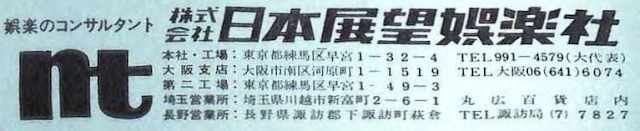
日本娯楽機 (Nihon Gorakuki) use the "nt" logo on some machines. This is taken from the 1969 machine directory.
Head Office/Factory: 1-32-4 Hayamiya, Nerima-ku, Tokyo TEL991-4579 (main representative) Osaka Branch: 1-1519 Kawaramachi, Minami-ku, Osaka TEL Osaka 06(641)6074 Second factory: 1-49-3 Hayamiya, Nerima-ku, Tokyo Saitama Office: Inside Maruhiro Department Store, 2-6-1 Shintomicho, Kawagoe City, Saitama Prefecture Nagano Office: Hagikura, Shimosuwa-machi, Suwa-gun, Nagano Prefecture TEL Suwa Bureau (7) 7827
In addition to "nt", they use the brand Nitten on some products:
it's hard to read, but I think that says Nitten
They released 4 machines that have a very distinctive cabinet, with cut-away side profile where the players' controls are.
1969 Socker Ace - サッカーエース (Soccer Ace) by 日本展望娯楽社 (Nihon Tenbo Entertainment Company — Nitten)
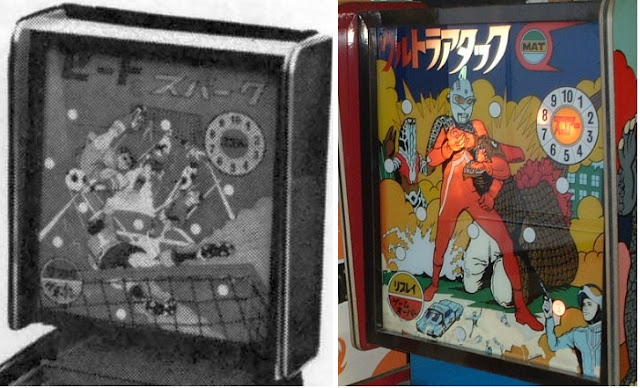
Why does the the Ultraman Attack control panel say "L Kick" and "R Kick"? Because it is the exact same control panel that Beat & Spark has.
ビート & スパーク (Beat & Spark) [Socker] by 東急商事株式會社 (Tokyo Corporation) & 日本展望娯楽社 (Nihon Tenbo) control panel and playfield detail
If we look at the playfields, they have the exact same layout, except for one difference: the bulb lights at the bottom right and left corners are higher up on Beat & Spark.
playfield detail via IPDB ウルトラアタック (Ultra Attack) by 日本娯楽機 (Nihon Gorakuki) & 日本展望娯楽社 (Nihon Tenbo) [presumed]
I think it is quite fair to say that these machines utilize the Nihon Tenbo game Beat & Spark as a base, with a fresh (and licensed!) art package on top of it. But there is even more evidence of this connection!
This post is for two games. At first glance, you might think it is an alternative backglass, but none of the display lamps line up. This would require a separate design for the backbox wiring. (the playfields also have slight differences, but more on that later)
So let's go back to Ultra Attack and compare backboxes to Beat & Spark:
all of the lamps are in the exact same position.
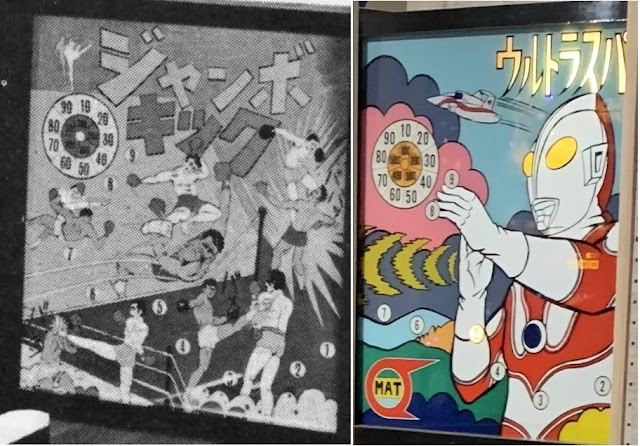
Ultra Attack has a backglass that aligns with the lamps for Jumbo Kick.
all of the lamps are in the exact same position.
When we compare the playfields and controls, we see that Ultra Attack is a Jumbo Kick with new artwork.
1970 ジャンボ キック (Jumbo Kick) by 東急商事株式會社 (Tokyo Corporation) & 日本展望娯楽社 (Nihon Tenbo) detail of control panel and playfield
playfield from Ultra Spark
controls from Ultra Spark
This is why I have added "日本展望娯楽社 (Nihon Tenbo) [presumed]" for the companies for Ultra Attack.
I only have a glimpse of it, but I want to note that Ultra Spark uses the same side cabinet art as the other model.
side art of Ultra Spark
Please note: I have no recollection of where I found Ultra Spark photographs. If you know where they are from, please do let me know!