Lucky Token, as it is commonly referred, is a slot machine that was unveiled at the 22nd A.T. E. Exhibition in the UK in 1966. It was brought by Taito Trading, and the full title on the marquee is "Strike A Lucky Token". Like most Sega slot machines of the time, it appears to be made specifically for export.
Cash Box 1966-02-12
F. Dennis Dent, Managing Director of Shipgoods Ltd., the agents for Taito Trading Company of Japan, is seen here (left) explaining the mechanism of the Lucky Token Fruit machine to Neville Marten (CASH BOX).
Cash Box 1966-02-12
Also exhibiting for the first time Taito Trading Company of Tokyo, Japan on the stand of their U.K. importers and distributors, Shipgoods Ltd. Managing Director Mr. F. Dennis Denton reported that the Lucky Token two plays for 6d 'pub' slot machine created tremendous interest, as did the Casey Jones kiddie train ride.
Coin Slot 1966-01-29
REGENT Automatic Supply demonstrated the Japanese fruit Strike a Lucky Token, which is on two pulls for 6d, and which pays out two coins in cash or a 5/- award. When the jackpot is won a buzzer sounds and a red light flashes next to the coin entry. An innovation on this machine is a special panel which can he unlocked by the site owner and through it he can load the award tube which might be in danger of emptying. A special light goes on when this may happen and goes out again when the tube in refilled. Thus the key can be safely left on site without any threat of unlawful access being gained to any other part of the machine.
Coin Slot 1966-01-22 ad from Regent Automatic Supply
Coin Slot 1966-02-05
Relevant text from the bottom, highlighting the feature of a special locked slot that allows the location owner to restock the payouts without gaining access to the cashbox or internals.
Bottom centre: Messrs. T. and A. Manzi, of Regent Automatic Supply, introduced the Japanese-made Lucky Token fruit machine. A feature of this fruit is that by unlocking a small plate on the front the site owner can restock the token tube without gaining admittance to the rest of the machine.
Coin Slot 1966-02-05 Zooming in on the Lucky Token photo
Lucky Token appears to be based on Royal Crown slot machines.
where the price is listed as 6D there is a key hole. I assume this is where the "lucky tokens" can be refilled by the location operator.
note the dual payout tray, one for the 2-coin payouts, and one for the lucky tokens
It says "Imperial Crown" here. Crown was a brand utilized by Taito as early as 1965. Unsure if that's a solid connection though since the original model design was Royal Crown.
is that "T" for Taito? On the Royal Crown machine this is instead a plastic circle with 'JP' on it. It probably just means "T" for "Token", as it lights when it pays them out.
inspection card! Inspected by T. Kaburagi on 1966-06-13
For comparison, a friend sent me a similar inspection card from the same era, this one from a Sega Mad Money machine:
1969-02-04 inspection date, this one is 110 Volts and 50 Watts, so for the Japanese market
The chevron on the Royal Crown and Lucky Token machines remind me of the one that would appear on サニー東京 (Sunny Tokyo) / Sunic machines
chevron from Royal Crown
chevron from Mercado Electrica - メリカー ドエレクトリカ by サニー東京 (Sunny Tokyo)
chevron from Wander 69 - ワンダー69 by サニー東京 (Sunny Tokyo)
Perhaps it was just stylish? But perhaps they saw Lucky Token and/or Royal Crown and were inspired. :)
One more advertisement, also from Regent Automatic Supply:
Coin Slot 1966-03-26
There does not seem to be any mention of their geographic origin in the ad copy, though the first ad did say "Introducing to England".
Also in 1966 Regent Automatic Supply began advertising Super Lucky Token, where they convert between "single jackpot payout" and "progressive jackpot", though I am unclear which is which. The sign still seems to say "Strike A Lucky Token" but Super Lucky Token is used in the ad copy.
Super Lucky Token by 太東貿易 (Taito Trading) & Regent Automatic Supply
Bombing appears in the 1966 Senyo Kogyo catalogue. The only image is from a for-sale ad for the catalogue.
image from a for-sale ad for the 1966 Senyo Kogyo catalogue
2 helicopters, one red one white, are suspended from the ceiling of the game. They are attached on opposite sides of a rotating shaft. The gameplay appears to be that the player presses a button to drop a metal ball from the helicopter on to the playfield.
In this video from 長島温泉 (Nagashima Onsen) we can see Bombing being played at 10:44. The game center footage begins at 10:23 and runs to 10:59. It's mostly rides, but there is also a shooting gallery we only see the guns from, and a bowling alley. (does anyone know when this video is from?)
It's not a great angle, but we at least can see the ball dropping.
As always, if you have ANY more information or insights about the games discussed here, please leave a comment or send me an email (thetastates@gmail.com)
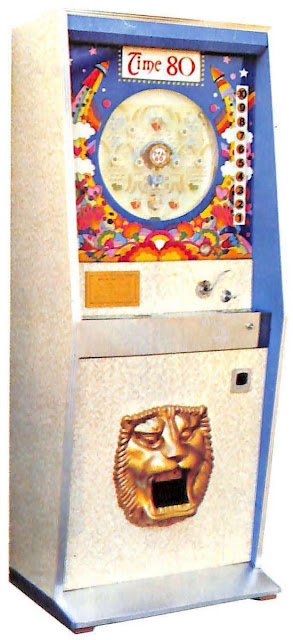
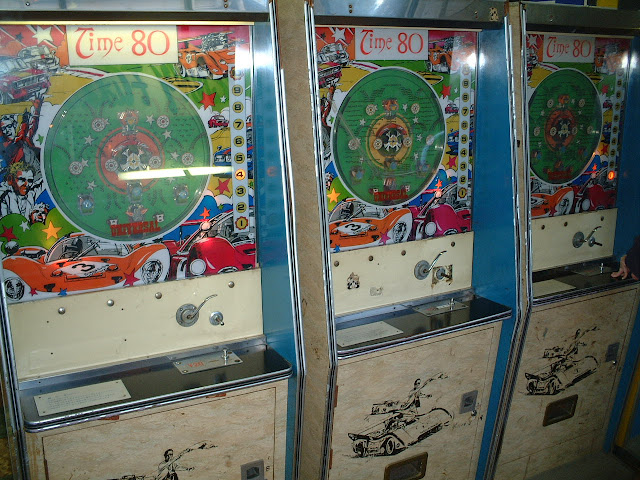
Time 80 is a popular arcade game where the player has to hit a number of pachinko jackpots in a limited amount of time. I have identified four artwork and cabinet variations of this game.
The first two have the iconic lion head prize dispenser, but different bezel art. The latter two have a stencil of a race car on the cabinet. One of the race car variants has a speaker grille.
This machine appears to have been copied by Play-Mate - プレイメイト by 新潟ジューク (Niigata Juke), but in all fairness there were already a number of similar games on the market since the 1960s.
The earliest appearance so far, with the original and more obscure artwork, was in March 1972.
Amusement 1972 – 03
We have scanned and shared two Universal corporate guides. In these documents, it lists Time 80 as 1970. That feels like a major discrepancy, and I wonder if that is one the project began and not when the game was released? Normally with a corporate document like that would I would defer to it, but in this case I am going to leave the year as 1972 until I can find further information.
If anyone has any corroborating evidence about Time 80 in 1970 or 1971, I would love to see it!
Excerpt from Universal corporate profile, approximately ~1981
If it was created in 1970, it was advertised as a new machine from Nihon Jidô Hanbaiki in 1972.
"Japan Vending Machine", which is always popular for its unique products, has released another hit product, "Time 80". It is a thrilling and interesting game machine that challenges the time suitable for the speedy era. After inserting 20 yen, you can play as fast as you want for 80 seconds. If you successfully get 10 balls in during that time, you will get a free caramel. It seems that another attraction for children has been added to the game, and it will surely be popular. <Specifications> Height 1670/m Width 670mm Depth 465/m Power AC100V40W Weight 55kg <Contact> Japan Vending Machine Co., Ltd. Headquarters 2-1 Nihonbashi-dori, Chuo-ku, Tokyo (Room 709, Daido Life Building) Tel: 03 (271) 4547~8 Osaka (office) 3-37 Satahira-cho, Moriguchi-shi, Osaka Tel: 06 (903) 0240
Time 80 does not appear in the 1972 machine directory, but does appear in the 1973 machine directory (which was printed at the end of 1972).
1973 machine directory
This is the most well-known version, with the sports car art and the lion-head dispenser.
In later versions, the lion head is gone, replaced by a rectangular slot. The cabinet now has a stencil of a race car.
I have no date reference for this specific cabinet, so I am assuming it is around 1973
In an advertisement from 1973, we can see an illustration of Time 80 with this stencil, blue cabinet, no speaker panel.
Amusement 1973 – 05
The off-white cabinet seems more obscure than this typical blue cabinet.
I am not considering the blue and off-white cabinets as separate games. But there is one more variation.
This version of Time 80 has a speaker grille
instead of the circular holes the grille here is horizontal lines. For the sake of the database, I am considering these to be the same machine.
this manufacturer plate is from the machine above, with the horizontal speaker grille. TAN 91-5539 日本自動販売機
Except for the very first version that we talked about, every Time 80 has the universal logo displayed front and center. This game would be followed up quickly by New Time 80.