Monday, 30 January 2023

Star Soccer - スター・サッカー by クロンプトン (Crompton) & セガ (Sega)


Name: Star Soccer - スター・サッカー
Year: 1969, first imported 1970
Company: クロンプトン (Crompton) & セガ (Sega)


Star Soccer is made by Crompton, from the UK and was released in 1969. I have been informed that Sega initially began distributing it in Japan in 1970: there is apparently a document for converting it to play using Japanese yen that is dated from 1970.
 
And we see it in 1970 inthis one photograph from Japan: 

1970


Coin Slot 1969-08-16


1972 machine directory index

The 1972 and 1973 directories list this game as being provided by セガ (Sega).  I do not know if Sega added their logo, but it is safe to assume they were distributing it in Japan.

1973 directory entry
On many Japanese games, Soccer is written as Socker


1975 Duck Shoot - ダック・シュート by セガ (Sega)


Name: Duck Shoot - ダック・シュート
Year: 1975
Company: セガ (Sega) 

The year of this game was confirmed to me by someone with experience at Sega.  I had seen it in a Sega catalogue that was printed around 1975, but I had never found any confirmation before.

This game does not appear in any of the machine directories, nor have I ever seen any magazines advertisements for it.


In November 1974, the game Duck Shooting was released by US Billiards at the MOA show.


Cash Box magazine 1974-11-09


Cash Box magazine 1974-11-16

Colour flyer for Duck Shooting, and we can see it is extremely similar to Duck Shoot


We can see the graphics were copied, but done in a slight stylistic variation.

1974 Duck Shooting by US Billiards

1975 Duck Shoot by Sega


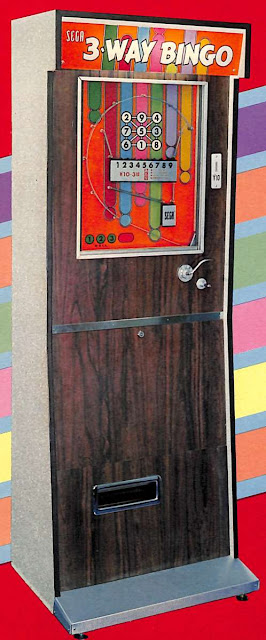
1973 3-Way Bingo - スリーウェー・ビンゴ by セガ (Sega)


Name: 3-Way Bingo - スリーウェー・ビンゴ
Year: 1973
Company: セガ (Sega)

I have received confirmation from someone who worked at Sega that 3-Way Bingo was released in 1973.  Prior to this source, this information was not publicly known. (to the best of my knowledge)
I am happy to share the information.

The playfield for 3-Way Bingo follows a template made popular in Europe in the 1960s.  The playfield is almost identical to Big Strike Bowling, a very simple machine that was popular across Europe.  


Big Strike Bowling (by NSM, 1960s)

Taito began importing and rebranding these machine around 1971.  Please see:  1971 Big Strike Bowling - ビッグ・ストライク・ボウリング by 太東貿易 (Taito Trading)

The hardware for 3-Way Bingo is a bit more advanced than Big Strike Bowling, which is mostly mechanical except for the lights, the ball release solenoid, and I think it also has a replay circuit.

3-Way Bingo gives you 3 shots, and a prize is paid out for any line of 3, or for lighting 3 of the 4 corners.

lit bingo card


The gameplay and design for 3-Way Bingo shows direct influence from other European games, like Jamieson's Bingo games.  Unfortunately, I do not know the dates of these European games, but we know when Britain changed their penny, so we can divide British machines into pre-decimilization, so before 1971, and post-decimilization which is 1971 and after.
According to a now-defunct website, this Bingo existed in pre-decimalization days, so 1970 or before:
Bingo by Jamieson

The next 2 machines are post-decimalization.  I do not know which year they came out, so I cannot be sure if 3-Way Bingo was directly influenced by them, or if it was just the style of the time.

Bingo by Jamieson
The playfield colours are somewhat similar to 3-Way Bingo.

Bingo by Jamieson
This machine seems to have taken inspiration from Japanese machines that preceded it, incorporating a dense pin playfield.


Regardless of when they were released, these games all have very similar gameplay.

1972 Safari - サファリー by タイトー (Taito)


Name: Safari - サファリー
Year: 1972
Company: タイトー (Taito)

In the 40th Anniversary Taito book there is a list of machines, sorted by date.  the list from 1972 includes Safari, but for the longest time I was unable to find any reference to Safari existing.  For a while, I thought it was a reference to Taito's Safari Rifle Range, but I was wrong.   Thank you to KT2 for your assistance.

mention of: サファリー (Safari)


In 1977 Taito would release a videogame called Safari.  Note that it uses the same side-art, but a number of games from that era also used the exact same side art.

1977 Safari by タイトー (Taito)

In 1980 Taito would release a roulette game called Safari:

1980 Safari - サファリ by タイトー (Taito)

That is probably too many games of the same name for one company.  :)

Wednesday, 18 January 2023

~1967 Home Run - ホームランゲーム by 日本展望娯楽社 (Nihon Tenbo)


Name: Home Run - ホームランゲーム
Year: ~1967
Company: 日本展望娯楽社 (Nihon Tenbo)


We can see Home Run in two different videos, both found by TOO_yoshikawa.

ザ・ガードマン (The Guard Man) episode 118 大泥棒一家
There are two copies of Home Run on the left.  This is from 1967.

Detail:


This next screenshot is from 喜劇 初詣列車 (Kigeki hatsumoude resha, 1968)


shared by TOO_yoshikawa

We can finally see the colours of Home Run!

I took some more screenshots:


It is blurry, but it's the best we've got so far!


Entry from the 1969 machine directory:


Sunday, 8 January 2023

~1929 岡式電気自動球遊機 (Oka-style electric ball play machine) by 岡 (Oka)

Name: 岡式電気自動球遊機 (Oka-style electric ball play machine)
Year: ~1929
Company: 岡 (Oka)


This is one the earliest pachinko machines.  When a winning hole was hit, the ball would hit a lever and trigger a bell that was attached to a battery.  The operator would pay out the prize through a slot / cup at the bottom.

rear view of machine


Saturday, 7 January 2023

~1931 岡式電気自動球遊機 (Oka-style electric ball play machine) by 岡 (Oka)


Name: 岡式電気自動球遊機 (Oka-style electric ball play machine)
Year: ~1931 (around 1930-1932)
Company: 岡 (Oka)


Oka are famous for making early pachinko machines, their oldest around 1929.  They are not the first to make pachinko machines, that would be ON Shokai.  There are no known existing copies of those machines, so currently the oldest known existing pachinko machine is by Oka.

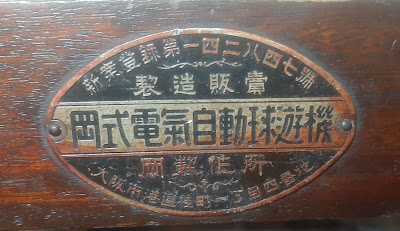
Oka company plaque.  Despite it saying "electric", only some of their machines used electricity.

The first pachinko machines operated on sen coins.  The earliest machines would have their wins paid by hand by the operator who would place coins in a bottom tray.  This is one of the early machines designed to automatically pay you coins for a win.  Pachinko machines would be changed to dispense balls around 1937, due to money gambling machines being prohibited by regulations.

Kazuo Sugiyama of the Birth Of Pachinko Museum says this machine was probably made between 1930 and 1932.


back of machine


Saturday, 17 December 2022

1966 Crane 605 - クラウンクレーンゲーム605 (crown crane game 605) by 太東貿易 (Taito Trading — Crown)

Name: Crane 605 - クラウンクレーンゲーム605 (crown crane game 605)
Year: 1966
Company: 太東貿易 (Taito Trading — Crown)


After years of searching, I found the above image of the 605 crane in テレビゲームの世界 2 [TV Game World 2; Games through the dawn (of video games)], scanned and uploaded by Detchibe.

The 605 had been mentioned in every Taito game list I've seen, but this is the only image I've been able to find after years of searching. 

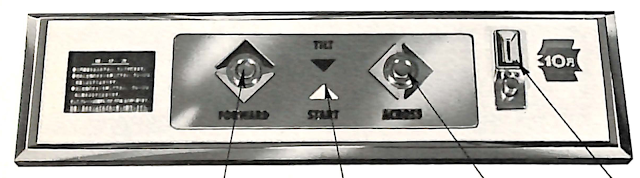
The 605 control panel has a forward and right button, but I do not know what the circle to the left of them is. It looks like a fancy counter-clockwise arrow circle, with a button in the center.  Perhaps this button mixes up the prizes? This is one of the very few Japanese cranes of this style that I've seen with a backbox marquee.


from the Taito 40th anniversary book

The 603 model was released the same year and was ubiquitous. I do not know how long the Crane 605 was made, but it seems to be exceptionally obscure.

Crown 603 - クラウンクレーンゲーム (crown crane game) by 太東貿易 (Taito Trading — Crown)


1966 Crown 603 - クラウンクレーンゲーム (crown crane game) by 太東 (Taito — Crown)

Name: Crown 603 - クラウンクレーンゲーム (crown crane game)
Year: 1966
Company: 太東 (Taito — Crown)


The Crown 603 seems to be the most common version of the 3 crane games Taito released in 1965 and 1966.  I say this because the flyer for it appears more often, and the very visible "Crown 603" at the top is easily recognizable.  

Does the Crown 602 also have a sign like that?  I am unsure.  It would definitely make things easier if it does.

As we mentioned with the Crown 602 post, the Crown 603 moves the coin slot to the control panel.


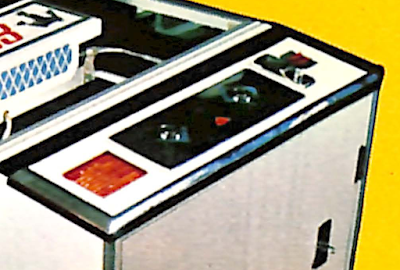
The control panel has a wide instruction card on the left side.


I do not know why, but the 603 and 605 cranes were both released in 1966.


Here is how the Crown 603 crane is listed in the 1969 machine directory, where we can see the Crown 603 sign at the top.

1969 machine directory


1965 クレーンゲーム [クラウン602] (Crane Game [Crown 602]) by 太東 (Taito — Crown)


Name: クレーンゲーム [クラウン602] (Crane Game [Crown 602])
Year: 1965
Company: 太東 (Taito — Crown)


The Taito crane games of the 1960s all have a distinctive profile.  From the side, you can see the front panel and back side each slope down.  From the front, the bottom flares out like a skirt.

Over the span of 2 years Taito released 3 iterations of their Crane Game: 602, 603, and 605.  I have not been able to find many details about why, but it is not uncommon for games in the 60s and 70s to be released in iterations where early problems are corrected and designs are improved upon in subtle ways.


All I have for the Crown 602 is the above flyer, and from that we can see distinctive details around the control panel.  The coin slot on the 602 is on the door.  The buttons are also further separated.

Crown 602

Crown 603

Taito's crane seems to copy the design of 2 Italian cranes.  The Automatico Crane was distributed by Jollymatic, who also distributed a basketball game that was the foundation of Sega's 1966 Basketball game. Jollymatic were not around for very long, and after exhibiting early in 1966 they seemingly disappeared by that same winter. But it seems a bunch of their flyers survived.
 
I think this crane was probably made by the company L'Automatico, but I have to find more information from the Italian coinop world. 

Automatico Crane by Jollymatic
via pennymachines.co.uk


Automatico Crane by Jollymatic

 
The above crane  is probably from 1964 or 1965.  In 1963 the model being sold was similar, but didn't have the same angle on the control panel.
 
La Gru Pesca 1963 by L'Automatico 

Automat # 2 [1963]


There is also the 33 R.M.G. Crane, which I believe came out early 1960s, but the only advertisement I have is from 1966. This crane has the same basic shape but also has a marquee, so the Automatico Crane design is more similar.
 
 33 R.M.G. Crane as seen in Coin Slot 1966-01-29


a foreigners' guide to eremeka arcades - 外国人のためのエレメカアーケードゲームガイド: introduction & main page - 紹介&メインページ

eremeka search tool  // エレメカ検索ツール begin browsing at the beginning / 最初から閲覧を開始する begin browsing at 1960 / 1960年代から閲覧する begin browsing at 1970...