Friday, 3 November 2023

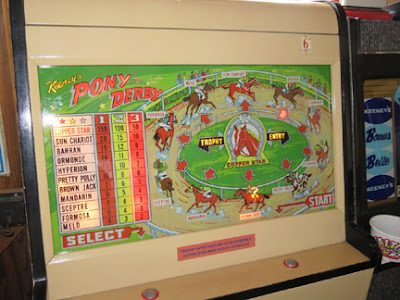
~1966 Pony Derby - ポニーダービー by さとみ (Satomi — Samy)

Name: Pony Derby - ポニーダービー
Year: ~1966
Company: さとみ (Satomi)
 
Pony Derby is a medal game seemingly built from parts of Keeney's machine. (I had originally spoken about this machine being an "import", but I have reconsidered. The source of the parts is irrelevant for designating the company.)

This tells us 里見治 (Satomi Hajime) was born in 1942.  He entered university in 1960, and while in university he began selling game amusement machines.  サミー工 業 (Sammy Industries) was founded in 1975.  They became サミー (Sammy Corporation) in 1997. 


23歳で独立してアミューズメント機の販売を始めた里見だったが、アミューズメント機の需要が多くなってくると、㈱セガや㈱タイトーなど大きなメーカーが製造だけでなく直接販売もするようになった。こうなると、メーカーからゲーム機を買って販売していた里見は価格面で太刀打ちできなくなった。
"Satomi started selling amusement machines independently at the age of 23, but as the demand for amusement machines increased, large manufacturers such as Sega Corporation and Taito Corporation began not only manufacturing them but also selling them directly.  When this happened, Satomi, which had been buying game consoles from manufacturers and selling them, was unable to compete on price."

That would mean that Satomi began selling amusement machines around 1965. The final sentence helps reinforce that these would be refashioned Keeney parts.


caption at the bottom:
(株)さとみが最初に市場へ投入したアミューズメント機 「ポニーダービー」
"Pony Derby, the first amusement machine introduced to the market by Satomi Co., Ltd."

If that text is accurate, it means the year for Pony Derby is probably close to 1965, but I will hedge on ~1966.


If you look closely, you'll see that it uses the "Samy" brand:

They dropped the "To" from Sa-to-mi to make "Samy".  By 1970 this would be spelled as "Sammy".


Pony Derby is a bit of a mystery to me.  It was a machine first made by Keeney in the USA in 1964.  There were many new laws against gambling machines in the USA (the latest wave began in the mid 1950s) and in the 1960s the legislation was altered to allow for transport of gambling machines.  Keeney was selling console slot machines to the UK market via Mar-Matic.

Cash Box 1964-02-01
Cash Box 1964-02-01
In that same issue we get a glimpse of the Mar-Matics booth at ATE.
it is nigh impossible to see, but beneath the "L" in Limited is a machine I believe to be a Keeney Pony Derby based on the rough cabinet shape, legs, and payout slot.
Cash Box 1964-02-01
Pony Derby was also scheduled to make an appearance at the 1965 ATE
Cash box 1965-01-23


The machines being brought into Japan are very different in appearance than the ones for the UK and USA.  (With that statement I am assuming there were still some select markets in the USA that they were sold to.)

Photos of a Penny Derby machine were shared by a collector in the UK:


I have not heard of anyone else owning or discussing one of these, so I am unsure if they were successful.  Given the lack of mentions in magazines and by collectors, I assume it was not a success compared to their other slot machines.

The Japanese Pony Derby also has an entirely different backglass than the regular Keeney Pony Derby.


Keeney's Pony Derby glass
via ipdb

This is the glass from the 1965 Satomi version.  The image was stretched to proportion from the single archival photo I've seen.

This is the same backglass we see on New Pony Derby:

~1969 Pony Derby - ニューポニーダービー (New Pony Derby) by 昭和娯楽物産 (Showa entertainment products) & 日本遊園設備 (Japanese amusement park equipment)


1964 Penny Derby (1D Derby) by Keeney
(note: this image has been stretched from its original form into the current perspective)


Thank you to Chris Dade for the revelation that what we see in Japan is actually a reworking of "Penny Derby", which was released at the same time as Pony Derby.  If you look at the Cash Box articles above, it is referred to as "1D Derby", 1D being how British currency referred to a penny then.

1964 Penny Derby (1D Derby) by Keeney

1964 Penny Derby (1D Derby) by Keeney


Satomi's Pony Derby uses the iconic metal castings that we see on both Keeney machines, Pony Derby and Penny Derby.


Note: These castings are not found on the machine "New Pony Derby".

The small metal payout cup is typical of Keeney slot machines of that era.

1963 Blue Spot by Keeney

The game play of Keeney's Pony Derby is very basic.  One button to select your horse, and one button to start.  The Satomi Pony Derby also has just these two buttons.  Earlier Keeney slot machines had an iconic metal handle that would rotate to start (see the Blue Spot photo above) but that was not used on Pony Derby, just the Select and Start buttons.


It seems that Keeney created a special version of this machine for export to Japan.  The differences:
  • Different cabinet dimensions
  • Different buttons locations
  • the backglass has many differences:
    • The odds are not on the glass
    • the name was changed from Penny Derby to Pony Derby
    • The Trophy Entry and Copper Star areas in the upper-right were moved further to the right.
1964 Penny Derby (1D Derby) by Keeney
flyer via Chris Dade


Saturday, 28 October 2023

~1933 菓子販賣機付玉運び機 (ball carrier with confectionery machine) by 日本娯楽機製作所 (Nippon Amusement Machine Manufacturing)


Name: 菓子販賣機付玉運び機 (ball carrier with confectionery machine)
Year: ~1933 
Company: 日本娯楽機製作所 (Nippon Amusement Machine Manufacturing)


This is one of the machines featured in the famous 日本娯楽商報 catalogue.  The actual paper catalogue is exhibited by Kaichi Endo in the 1992 TV program "TVムック故郷は欧州 意外なパチンコ進化論".

The TV footage zooms in and gives us some detail that the scan available online does not.


A photograph of this machine is republished in the Kazuo Sugiyama book, ものと人間の文化史 188 玉ころがし by 杉山 一夫 (Cultural History of Things and Humans 188 Rolling Balls by Kazuo Sugiyama).

[1933年7月、影山光洋撮影の「松屋スポーツランド」(影山光洋著『ある 報道写真家の見た昭和30年史』雄鶏社、1955年)]
["Matsuya Sports Land" photographed by Koyo Kageyama in July 1933 ("A Report Photographer's View of the Showa 30 Year History" by Koyo Kageyama, Okeisha, 1955)]

The 1933 photograph is the earliest instance I have seen for this game, thus ~1933.


This style of gameplay was resurrected in 1980 by 友栄 (UA) for the game たまあけゲーム (Tamaake Game).

1980 たまあけゲーム (Tamaake Game) by 友栄 (UA)

and then again 1981, by a different company:

           1981 The Shinobi - ザ・シノビ by テーカン (Tehkan) 


Wednesday, 25 October 2023

1960s~ スーパーホームランゲーム [PH-51型] (Super Home Run Game [PH-51 type]) by 東洋プレーイングマシン (Toyo Playing Machine)

Name: スーパーホームランゲーム [PH-51型] (Super home run game [PH-51 type])
Year: unknown, probably early 1960s
Company: 東洋プレーイングマシン (Toyo Playing Machine)


This flyer recently came up for auction and sold for 51,000 yen.  We had bid 7500 yen on it and did not win the auction.  If you acquired this flyer, can you please get in touch?


This is the first time we have ever seen the company 東洋プレーイングマシン (Toyo Playing Machine).  
This is different from the 1920s company 東洋自動娯楽器商會 (Toyo Automatic Entertainment Equipment Business Association). 
And this is not the 1970s company 東洋娯楽機 (Toyo entertainment machine) which would later be known by the brand name トーゴ (Togo).

A friend of mine notes that the characters used on the flyer are older.  In 1959 the Ministry of Education announced a new typeface would be used, but this flyer used the old style Kanji with Chinese characters.

That does NOT guarantee this flyer is from the 1950s, but I am suspicious that it is.  The flyer seems to say it has been a decade of Super Home Run Game, but I do not think I am understanding the translation properly.  Did this game exist for a decade?  If so that would definitely push this flyer closer to 1960.  How are we only rediscovering it now?

Previously, the oldest Japanese flipper pinball was 1965 クレイジー15 (Crazy 15) by こまや (Komaya) but if we can verify this machine is from before 1965, it will take that title!

Nazox2016 has also been investigating this flyer.  Paraphrasing what he told me: There area where Atami Center is used to be a red light district.  An anti-prostitution law was enacted in 1957 and the red-light district was abolished in 1958.  We are assuming the Atami Center moved into that building 1958 or later.  Because of that, I believe it is most probably that this flyer is from the early 1960s.  There is a chance it could be from the 1950s, but I think says "~1960s" is a far safer bet.


One thing to note about this flyer is that it appears to show 3 different backglasses for what appear to be the same machine.  No game other than Super Home Run Game is mentioned on the flyer.  We can see glimpses of the playfield on all 3 images, and they all appear to have the same playfield.

I am unable to discern what is on this backglass, but we can confidently say that it is not the same image as the two backglasses below.
backglass shows a woman on the lower left, and a distinctive outline in the lower right.
backglass shows a woman front and center.

For the first 2 images, we see that the side art differs between them.  For images 2 and 3 we see that the front cabinet art is different.

Each backglass is similar in how the score is shown.  There is a large "50,000" near the top.  The 2nd row says 10,000 20,000 30,000 40,000.
3rd row is 1000 through 9000, bottom row is 100 through 900.  This is how pinball scores were displayed before the invention of reels.  Lights would illuminate your current score, and you would add up the 10k, 1k, and hundreds section for your total.


Let's look at the diagram in the flyer:

The notes about points are self explanatory.
バット translates to 'bat', aka the flippers, but 'bat' works quite well for a baseball theme.
始動用メタル入金具 (Metal fitting for starting) is the coin slide
ボール送り出ミ金具 (ball delivery fitting) raises the ball to the shooter lane

The most curious part above is the 景品メタル受金具 (prize metal bracket).  It seems this has a slot to dispense winning tokens / coins to players!!  If true, that is a remarkable addition.  


Super Home Run Game seems to be a repainted version of Exhibit Supply's 1948 machine Banjo.

Here is a side-by-side comparison of the playfields, in black & white:

the playfield has been repainted.  The center circle, beneath the three bumpers, is now painted to look like a baseball.
The lower bumpers were changed from diamond shaped to circles.


For readers outside of the USA, it's important to note that the game Banjo uses the 'minstrel' stereotype.  Blackface and minstrel iconography are part of the history of racism in the USA.


1948 Banjo by Exhibit Supply (aka ESCO)

nice playfield shot


this is a shot from inside the cabinet.  As you can seem, Banjo has no payout mechanism at all.  Most "payout pinball" was discontinued pre-ww2.  There were some one-ball horse race pinball machines in the 1940s that had payout hoppers, but none built into the side of the cabinet like Super Home Run Game.


the score instructions for Banjo.  The scoring seems altered for Super Home Run Game, and at the very least the score values have been divided by 10.  

Banjo offers scores up to 699,000.
Super Home Run Game offers scores up to 59,900.


While the side art for Banjo and Super Home Run Game are different, it is interesting to note that Super Home Run Game also has musical notes.

left side art (right side is the same)
1948 Banjo by Exhibit Supply

is that a baseball glove?


I should also note the differences in the backglass frame.  Around 1948, Exhibit Supply stopped using their fancier top wood trim and instead switched to a more economical trim.  
While Banjo's promotional material show it with a larger top wooden trim, the game seems to exist with both types of frame.  Mind you, we are 75 years past when it was made so the few existing Banjos today might have lost and gained parts over the years.
A month after Banjo, Exhibit Supply released Samba, with a nearly identical playfield except for the center feature, and the economical backglass trim.

fancy trim on a Banjo
economical trim on a Banjo


And just for fun, here's Samba's playfield
1948 Samba by Exhibit Supply
note how Samba does not have the center drain post, but also a kickback lane near the center bottom.  The other main difference is that the center gate bounded by triangles on Banjo is replaced with a kickout saucer on Samba.


Monday, 2 October 2023

1970 Air Fighter - エアーファイター by 関西精機 (Kansai Seiki — Kasco)

Name: Air Fighter - エアーファイター
Year: 1970
Company: 関西精機 (Kansai Seiki — Kasco)


English-language advertisement

Saturday, 16 September 2023

book: ミニドライブ大百科 (Mini-Drive Encyclopedia)

I am very excited about this new book I received from Japan!

ミニドライブ大百科
Mini-Drive Encyclopedia
by オニオン製作所 (Onion Seisakusho)

Order this book through Beep Shop!  (There are links for international shipping)

These page images taken from the Beep Shop page:


You are probably familiar with Onion Software via their youtube channel.  They are a legend of game history!   Their website lists many things they have published.

I am very grateful for this book.  It contains a few bits of information that I previously did not have.  It includes a very special photograph: the Playtron cabinet!  Kansai Seiki (Kasco) showed off this prototype in 1973 and had it gone to production, it would have been the first colour videogame.  Up until today, I had never seen a picture of the cabinet.  No one I knew, even in Japan, had seen this before!

1973 Playtron - プレイ トロン [prototype] by 関西精機 (Kansai Seiki — Kasco)

Thank you so much, Onitama-san!

Other pieces of information that are new to me:

  • It has an amazing photo of a games parlor in Japan from the 1910s!!  That is the earliest photo of a coin-operated arcade setup in Japan that I have ever seen.
  • It has the Kansai Seiki gun-series flyer from the 1960s in colour!!  It is a small reproduction, but it fills me with hope that one day I can get a proper scan of that flyer in colour.
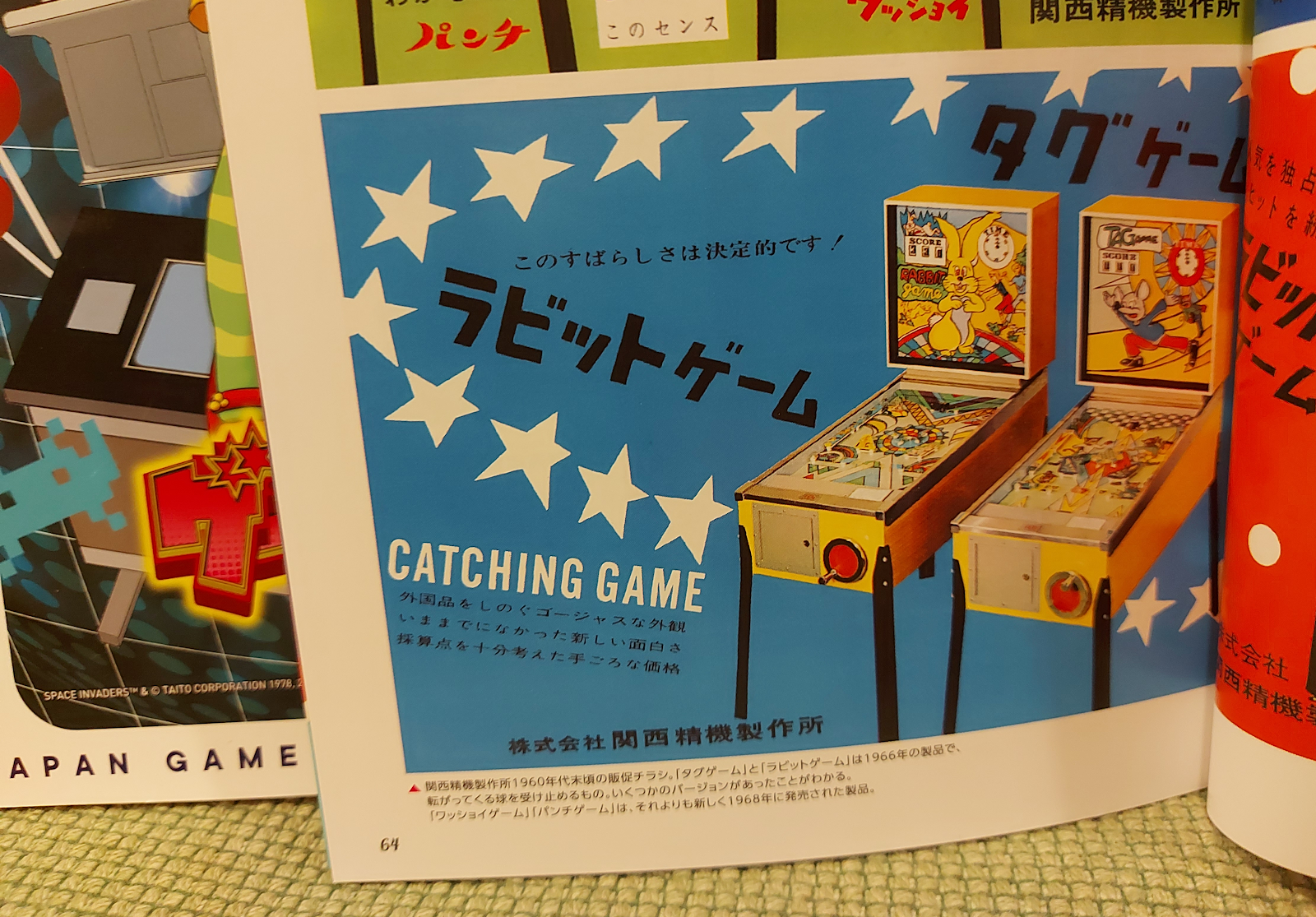
  • It shows off a different version of "Western Tag Game - タグゲーム" that is just called "Tag Game".
  • It says Rabbit Game and Tag Game were both from 1966, and that ワッショイゲーム (Wasshoi game) and Punch - パンチゲーム are from 1968
  • I only had Clay Shooting - クレイシューティング as being 1974, but this book says it was 1973.
  • It shows a photo of the prototype ミニドライブ [アップ ライト] (mini drive upright) that preceded ポルル君の旅行 (Poluru's trip).  I had never seen it before.
  • It says Indy 500 [M] was 1968, a year earlier than I had found it.  And it says Indy 500 [W] was 1969, where I only had info giving it as 1970.  I'm grateful to have this improved accuracy.
  • Gave 1968 as the year for Caliber-50 - キャリバー50 by 三共 (Sankyo) when I previously only had it as ~1969
  • Verified the year of 1963 for Red Gun - レッド・ガン, which I previously only had as ~1963
  • gives 1968 as the year for Caliber-50 - キャリバー50 by 三共 (Sankyo)

I highly recommend purchasing this book if you are in to electromechanical games.  Thank you Mr. Onionsoft.


a foreigners' guide to eremeka arcades - 外国人のためのエレメカアーケードゲームガイド: introduction & main page - 紹介&メインページ

eremeka search tool  // エレメカ検索ツール begin browsing at the beginning / 最初から閲覧を開始する begin browsing at 1960 / 1960年代から閲覧する begin browsing at 1970...